Best Power Tools For The Money
Our Top Picks
 SKIL 5” Random Orbital Sander with Cyclonic Dust5 inches7.87 x 4.8 x 5.51 inches3.44 poundsCheck on Amazon


What's inside
As an Amazon Associate I earn from qualifying purchases. This post may contain affiliate links at no extra cost to you.
Sticker price is the worst way to judge a cordless tool. The best power tools for the money are the ones with the lowest cost per finished job over three to five years, and that number is set by battery cost, brushless efficiency, and how often the platform goes on real discount. A bottom-of-the-band drill that needs a new pack in eighteen months was never cheap. A mid-band kit bought at 35 percent off with two usable batteries in the box usually is.
Everything below runs in price bands and percentage thresholds rather than live prices, because cordless pricing swings 20 to 40 percent across a calendar year and any figure published today is stale in a month. The math does not move: some categories reward spending more, some flatten out early, and two retail tricks make an ordinary promo look like a blowout.
| Category | Typical street band | Discount worth acting on |
|---|---|---|
| Brushless drill and impact combo kit | $180-$280 | 30 percent or better with two 2.0Ah packs |
| Bare-tool impact driver | $80-$150 | 25 percent or better, platform owners only |
| 6-1/2 in. cordless circular saw | $100-$180 | Skip under 25 percent, stock is constant |
| 5 in. random orbit sander (corded) | $60-$120 | 20 percent or better, recon units count |
| Oscillating multi-tool | $80-$160 | 35 percent or better, blades outcost the tool |
What the best power tools for the money have in common
Three things decide your total spend, and none of them is the number on the shelf tag.
The battery is the real product
On most 18V and 20V class kits, the cells and charger account for roughly a third to half of retail. That is why bare tools look absurdly cheap, and why a free-battery promotion is often the deepest discount available in a given month. It also means the platform choice outweighs any single tool. Once you own three or four packs and a fast charger, every later purchase drops to bare-tool pricing, which typically runs 40 to 60 percent under the equivalent kit.
Brushless pays back above a certain duty cycle
Brushless motors add roughly 20 to 40 percent to a tool’s price and return more torque, longer runtime per charge, and better heat behavior under load. On a drill used once a month, that premium is hard to justify. On an impact driver, circular saw, or grinder that runs loaded for minutes at a time, it pays back through battery cycles and tool life. DeWalt XR, Milwaukee FUEL, and Makita LXT all carry deep bare-tool catalogs, which matters more over a decade than the badge on the motor. Price a year of blades and sanding discs as well, because a bargain multi-tool quietly eats the difference.
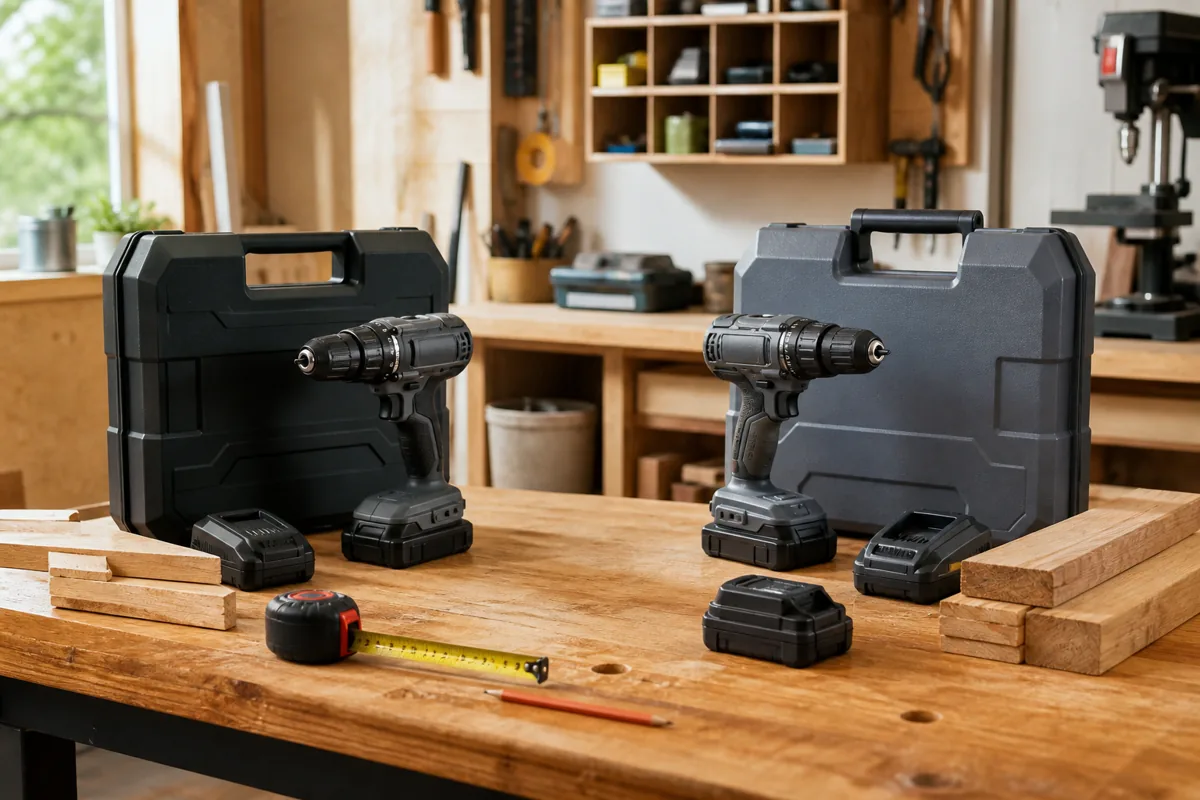
Brushless drill and impact driver combo kit
The strongest value buy in cordless, but only on promotion. Hold out for 30 percent or better off the typical band, confirm the listing specifies two batteries at 2.0Ah or higher, and count the charger as part of what you are paying for. Below that threshold, the same kit comes back cheaper within a quarter.
Where the value actually sits
Drilling and driving
The mid-tier kit beats both ends. Entry kits cut corners on the chuck and ship the smallest packs in the line, while flagship kits sell torque you cannot brace against inside a stud bay. Brushless, middle of the band, two batteries.
Saws
Corded wins on dollars per cut for miter and table saws, and it is not close. A cordless circular saw makes sense once the batteries are already paid for, since the bare tool costs about what a decent corded model does. Cordless miter saws are a convenience purchase, not a value one.
- ✔ Kits bundle the batteries and charger, which is where most of the cost lives
- ✔ Kit promotions routinely reach 30 to 40 percent, deeper than bare tools ever go
- ✔ One platform decision sets up years of cheap bare-tool add-ons
- ✘ Kits often ship the smallest compact packs offered in that line
- ✘ An unwanted third tool gets bundled in to pad the perceived value
- ✘ Was-prices on kits are inflated more aggressively than on bare tools
How to read a power tool deal without getting played
The battery downgrade
The most common move in cordless retail is relisting a familiar kit with smaller cells. Same model family, same marketing photo, 1.5Ah or 2.0Ah packs instead of 4.0Ah or 5.0Ah, price down 15 to 25 percent. Read the amp-hour rating in the bullets, not the title. Compact packs are fine for drilling and driving, but they roughly halve runtime on a saw and sag harder under load.
The inflated was-price
A strikethrough figure that existed for two weeks last November is not a reference price. Judge every discount against the band the tool held across the whole year. If a listing claims 45 percent off and the result lands inside the range it sat at all spring, the real discount is zero. Price-history tools and a retailer’s own recent-price language beat any percent-off badge.
Do the kit math at checkout
Subtract what the included batteries and charger cost on their own from the kit price. If the remainder sits at or under the bare-tool price, the deal is real. Factory reconditioned units from authorized outlets run 25 to 40 percent below new with shorter warranties, which is a fair trade on saws and grinders and a worse one on electronics-heavy tools.
Bare-tool impact driver
Once the batteries are paid for, bare tools are the cheapest way to grow a kit. An impact driver is the right first add-on because it pulls screw-driving abuse off your drill and roughly doubles working speed on deck and framing work. Set a price alert and buy at 25 percent or better, since bare tools rarely fall much further.
When to wait and when to buy
Cordless discounting follows a calendar. Late November into mid-December is the deepest window of the year on combo kits. March through mid-June runs second on saws and outdoor gear, and midsummer sale events skew toward bare tools and accessories. Late January and September are the flattest months.
Buy now when your working tool has failed and a job is stopped, when the discount clears the threshold in the table, or when a line refresh pushes the outgoing generation to 30 to 50 percent off. That clearance is usually the best genuine value in tools, since the previous brushless platform is rarely worse in any way you notice in a stud wall.
Wait when the discount is under 20 percent in a category with year-round stock, when you are buying a kit purely to obtain batteries a free-pack promotion will hand you later, or when the tool is brand new to market. First-generation pricing holds firm for two or three quarters.
5 in. random orbit sander
The most underrated dollars in a home shop. Mid-band corded models beat cordless on both price and runtime, and there is nothing to keep charged. Look for hook-and-loop pads, a dust port that fits a shop vac hose, and a body you can hold for an hour without numb fingers.
Frequently asked questions
Is a budget brand ever the right answer? Yes, for tools you use a few times a year and for single-job specialty gear. Budget lines usually sit 40 to 60 percent under name-brand kits, which is real money at low duty cycle. They get expensive when you depend on them weekly, because replacement packs are proprietary and support is thin.
How big a discount should I hold out for? Around 25 percent off the typical street band is the floor on bare tools, 30 percent on kits, and 40 to 50 percent turns up on outgoing generations during a line refresh. Under 20 percent in a well-stocked category is not a deal, it is a Tuesday.
Do I have to stay on one battery platform? Mostly yes for your 18V or 20V class tools. A second system is defensible when it is a 12V compact line for cabinet, trim, and overhead work. Three platforms means duplicate chargers and packs that sit uncycled, which is how batteries die of neglect rather than use.
Value in tools is arithmetic, not brand loyalty. Pick one platform, buy the first kit only on a real discount, check the amp-hours before you pay, then add bare tools at 25 percent or better and stop paying retail for batteries.
Check prices on Amazon →