Best Value Cordless Ratchet for Tight Automotive Spaces
What's inside
As an Amazon Associate I earn from qualifying purchases. This post may contain affiliate links at no extra cost to you.
A cordless ratchet earns its place in an automotive toolbox when a normal ratchet is too slow and an impact wrench is too bulky. The best value is usually a compact 3/8-inch model on a 12V or 18V battery platform, not the tool with the highest advertised torque. In tight spaces, head thickness, trigger control, and battery size matter more than another 20 ft-lb of breakaway rating.
As an Amazon Associate we earn from qualifying purchases at no extra cost to you.


What matters in tight automotive spaces
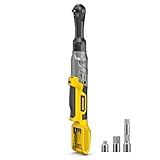
Measure the tool’s head and body, not just its overall length. A ratchet with a slim 2.0-inch head can fit between a frame rail and an engine where a 2.5-inch model cannot. A shorter battery also helps when you are working behind a dashboard, near a suspension mount, or under an intake manifold.
Look for a 3/8-inch drive unless your work is mostly small fasteners. It covers common automotive sizes from roughly 8 mm through 19 mm and accepts inexpensive sockets. A 1/4-inch ratchet is easier to fit into cramped areas, but its anvil and square drive are more vulnerable to twisting. A 1/2-inch cordless ratchet is generally too large for the “tight spaces” job and overlaps with compact impact wrenches.
Speed is useful after the fastener has been broken loose. A no-load speed around 200 rpm is noticeably quicker than 160 rpm when removing long bolts, but speed becomes less important if the ratchet has poor trigger modulation. A variable-speed trigger lets you start a nut without cross-threading it. A forward/reverse switch that can be operated with one hand is also worth paying for.
Cordless ratchet value comparison
| Type | Typical bare-tool price | Best use | Main compromise |
|---|---|---|---|
| Budget 12V 3/8-inch | $60–$110 | Occasional repairs and interior work | Lower durability, slower charging, weaker warranty support |
| Brand 12V 3/8-inch | $120–$190 | Regular automotive maintenance | Battery and charger can make the kit expensive |
| Compact 18V 3/8-inch | $130–$220 | Heavier fasteners and shop use | Usually thicker and heavier in confined areas |
| High-torque cordless ratchet | $180–$300 | Frequent professional work | Cost and size; still not a substitute for an impact wrench |
Prices vary with battery size and promotions. A bare tool looks cheap until a battery and charger add $60 to $150. If you already own batteries, stay within that platform unless the competing tool is dramatically better. Buying a new battery system for one ratchet is rarely the value choice.
When a budget ratchet is enough
A budget 12V ratchet is fine for oil-pan shields, battery trays, hose clamps, interior panels, and bolts that have already been loosened by hand. It can also be a good second tool for a home garage. For those jobs, the useful features are a small head, an LED, a comfortable trigger, and a battery that does not extend far behind the grip.
Do not expect a low-cost ratchet to remove rusted suspension bolts. Many inexpensive units are rated around 30 to 45 ft-lb of working torque, and real performance drops with a nearly empty battery or a cold pack. Use a breaker bar to crack the fastener loose, then use the ratchet to spin it out. Trying to force a seized bolt can strip the gears, overheat the motor, or break the ratchet head.
For a first purchase, compare budget 12V 3/8-inch cordless ratchets by head size, included battery capacity, and warranty rather than by peak torque alone. A kit with a 2.0Ah battery is generally more useful than one with a tiny 1.5Ah pack, although the larger pack may reduce clearance.
When a brand platform is worth the premium
Pay more for a major battery platform if you use the ratchet weekly, need replacement batteries locally, or work on customer vehicles. Better-supported tools typically have stronger gearboxes, more consistent triggers, and parts or service options. The premium also buys compatibility with compact drills, lights, and impact drivers you may add later.
Battery capacity is a trade-off. A 2.0Ah pack keeps the tool compact and is usually enough for a day of intermittent automotive work. A 4.0Ah pack runs longer but can make the tool awkward between suspension components. For work inside an engine bay, choose the smallest battery that gives reasonable runtime.
Compare 12V automotive cordless ratchet kits when you need both the tool and battery. Kit pricing often drops during seasonal sales, while bare-tool discounts may be less impressive. Check whether the kit includes a charger, a socket set, or only a soft bag; bundled sockets should not justify a large price increase if you already own quality sockets.
How to use one without breaking it
Always start the fastener by hand for several threads. Run the ratchet at low speed until the nut or bolt is clearly engaged, then increase speed. Stop using the motor for final tightening. Most cordless ratchets are not torque-controlled, and holding the trigger after the fastener stops can damage the mechanism or stretch a small bolt.
Keep a manual ratchet or breaker bar beside it. Use the hand tool for initial loosening and final tightening, especially on wheel, brake, steering, and suspension hardware. Follow the vehicle’s torque specifications; a cordless ratchet is a convenience tool, not a torque wrench.
Common failure modes include a slipping direction selector, a clicking gearbox under load, and a dead battery that charges but delivers little runtime. A ratchet that clicks without turning may have damaged gears or an overloaded clutch. Do not keep pulling the trigger to “push through.” Remove the load and inspect the socket and fastener first.
When to buy for the lowest price
Tool prices usually improve around Black Friday, holiday sales, Father’s Day promotions, and spring garage-season events. Battery kits often receive the deepest discounts because manufacturers want to add users to a platform. Watch for a free-battery promotion or a kit priced close to the bare tool; that can be a better deal than a modest percentage discount.
For the best value, buy a compact 12V 3/8-inch ratchet from a battery platform you already own. Choose a budget model for occasional, low-load work. Choose a supported brand kit when the tool will be used every week or when downtime costs more than the initial savings. If clearance is the deciding factor, inspect product photos and published head dimensions before comparing torque figures.