Best Value Wallpaper Steamer for Removing Old Wall Coverings
What's inside
As an Amazon Associate I earn from qualifying purchases. This post may contain affiliate links at no extra cost to you.
A wallpaper steamer can be a good-value buy if you have several rooms to strip, or if old wallpaper is resisting a scraper and stripping solution. For one small wall, renting or borrowing may cost less than buying a machine you will rarely use. The best value is not necessarily the cheapest steamer: tank capacity, replacement parts, hose quality, and the time you spend waiting for heat all affect the real cost.
As an Amazon Associate we earn from qualifying purchases at no extra cost to you.


When a steamer is worth buying
Steam softens wallpaper paste so the paper can be lifted with a scraper. It is especially useful on multiple layers or stubborn paper, but it is not a guarantee of quick removal. Vinyl-coated wallpaper may need its surface scored or perforated first so steam can reach the backing. A sharp scraper and patience still matter.
For a single accent wall, a basic wallpaper steamer can be cheaper than paying a professional, but compare its price with local rental rates before buying. For a whole home or repeated renovation work, buying makes more sense because you avoid rental pickup, return deadlines, and availability problems.
What good value looks like
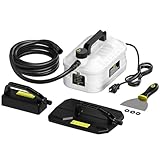
Most consumer units have a water tank in the range of roughly 2 to 5 litres and a hose connecting it to a flat steam plate. A larger tank means fewer refill breaks, but it also adds weight and takes longer to heat. Check the stated heat-up time, but treat it as an estimate: a cold garage, hard water, and a full tank can all affect how long you wait.
Look for a stable base, a hose long enough to reach the wall without pulling the tank, and a plate that is easy to hold against a large area. A hose that kinks or a plate that leaks steam around its edges can make a low sticker price a false economy. Before buying, check whether the maker sells a replacement hose, plate, or cap. If a small break makes the unit unusable, a bargain price may not be worth it.
Compare the main options
| Option | Best for | Value trade-off |
|---|---|---|
| Entry-level consumer steamer | One or two rooms, occasional DIY | Lowest purchase cost; may have a smaller tank, fewer accessories, or limited replacement parts |
| Mid-range consumer steamer | Several rooms or repeated home projects | Usually a better balance of capacity, hose reach, and build; costs more upfront |
| Rental steamer | One-off job with a tight budget | No storage or maintenance, but rental fees, travel, and return timing add cost |
| Scraper and stripping solution | Small area or paper that releases easily | Cheapest to start; can be slow and tiring on multiple layers |
For occasional use, a budget wallpaper steamer kit is often sufficient if it has a sound hose, a stable tank, and a plate large enough for the job. A higher-priced unit is easier to justify when you are stripping multiple rooms or expect to use it again. Do not pay extra just for a long accessory list if you already own a scraper and floor coverings.
Estimate the real cost
Compare the total cost, not just the shelf price. Add any rental fee, transport, scraper, plastic sheeting, and the time spent waiting for the machine. A steamer that holds 4 litres may reduce refill interruptions compared with a 2-litre model, but only if its extra capacity is useful for your wall size. Small rooms and narrow sections may not benefit much from a larger tank.
Also check what the price includes. A scraper may be bundled with some kits, while other packages include only the steamer, hose, and plate. A replacement blade is inexpensive compared with damaging plaster by using a blunt or overly aggressive scraper. Compare current prices from several sellers; wallpaper steamers are often discounted during home-improvement sales, but a sale is only worthwhile if the unit suits your job and has usable warranty support.
Avoid common failures
Do not leave a hot plate pressed against one spot for too long. Excess heat and moisture can damage plasterboard, loosen plaster, or soften older paint. Work in short sections, follow the manufacturer’s instructions, and test a discreet patch first. Keep steam away from electrical outlets, switches, and fixtures; turn off the relevant circuit where appropriate, and never direct steam into an opening.
Some wallpaper will come off in broad sheets; other paper separates into a wet surface layer and stubborn backing. Score resistant or vinyl-coated paper lightly, taking care not to gouge the wall. If the wall is damaged, crumbling, or covered in several unknown layers, slow down: more steam and harder scraping can make repairs far more expensive than the tool you saved money on. Older buildings may have paint that requires testing for lead before you disturb it.
Use clean water and empty the tank after the job. Mineral deposits can clog a steamer, especially in hard-water areas. Follow the manual’s descaling instructions rather than adding household chemicals that the manufacturer does not approve. Let the unit cool before draining or storing it, and keep the hose and plate dry to limit corrosion and residue.
Which buy makes sense?
Choose a basic consumer steamer for a small number of rooms when the walls are in decent condition and you are comfortable working section by section. Choose a more robust mid-range unit if you have several rooms, difficult wallpaper, or plans to reuse the machine. Rent if this is a one-time job and local rental costs are clearly below the purchase price. For a small, easy-to-strip area, start with a scraper and stripping solution; the steamer is not automatically the best value.
Before ordering, measure the work area, check the tank capacity and hose length, and read the warranty and spare-parts information. Those details are more useful than a large accessory count or an impressive wattage figure. A modest steamer that works reliably, stays stable, and can be serviced is better value than the cheapest unit that fails halfway through the room.