Bosch 12V vs Milwaukee M12: Comparing Compact Tools for Small Jobs
What's inside
As an Amazon Associate I earn from qualifying purchases. This post may contain affiliate links at no extra cost to you.
Bosch 12V and Milwaukee M12 both make sense when a full-size drill or impact driver feels bulky for the job. Their compact tools can fit inside cabinets, work between joists and handle routine repairs without dragging a heavier 18V kit around. The choice is less about which badge is better and more about tool selection, battery cost and whether you expect to expand the system.
Prices vary by retailer, kit contents and sales, so compare the actual package rather than just the bare tool. A kit with two batteries and a charger may be better value than a discounted tool-only deal if you are starting from scratch.
As an Amazon Associate we earn from qualifying purchases at no extra cost to you.



Quick comparison
| What matters | Bosch 12V | Milwaukee M12 |
|---|---|---|
| Best fit | Compact everyday tools and users who already own Bosch 12V batteries | Broad compact-tool range and users building an M12 collection |
| Small-job performance | Plenty for cabinet hardware, pilot holes and routine assembly | Plenty for the same work, with more specialty-tool choices in the system |
| System value | Strong if batteries and chargers are already on hand | Strong if you will use several M12 tools or find a well-priced starter kit |
| Main trade-off | Fewer options in some specialty categories | More choice can mean more spending on tools and batteries |
Neither platform is automatically the cheaper one. Kit prices change, and a bare tool is only a bargain if you already own a compatible battery and charger. Compare the total cost of the tool, at least one battery, charger and any second battery you will need for a full day.
What 12V can—and cannot—do
For small jobs, a 12V drill or driver is often the sensible size. It can handle furniture assembly, shelf brackets, cabinet hinges and pilot holes in ordinary lumber. The smaller body is easier to steady overhead and less likely to bump into a cabinet wall. For occasional repairs, those advantages can matter more than maximum torque.
But 12V is not a guarantee that every task will be easy. Driving long structural screws into dense framing, drilling large holes with a spade bit or mixing material can push a compact tool hard. The tool may slow, batteries may run down quickly, and repeated heavy work can heat the motor or battery. If your jobs regularly involve 3-inch construction screws or large holes, an 18V drill is a better primary tool. You can still keep a 12V driver for tight spaces.
Bits matter, too. A dull bit, poor pilot hole or screw driven at an angle can stall a compact driver and make it seem underpowered. Use sharp bits, match the bit to the fastener, and start long screws with a pilot hole when the material calls for one.
Choosing between Bosch and Milwaukee
Milwaukee’s advantage is the breadth of its M12 lineup. If you want to add compact tools beyond a drill and impact driver, that range can make it easier to keep one battery system for several jobs. Before buying, check that the exact tool you need is available on M12; some categories and tool types are more commonly found in larger-voltage lines.
Bosch 12V is a good choice when its tools meet your needs and the price is right. If you already have Bosch batteries, adding another compatible tool can be cheaper than switching platforms. For a homeowner who needs a compact drill, light and perhaps a small saw, the range may be enough. There is little value in paying extra for a larger ecosystem if you will never use the extra tools.
Check battery compatibility before ordering. Brands sometimes have different battery families, and batteries within one brand are not necessarily interchangeable across voltage platforms. Read the product listing and tool manual rather than relying on a similar-looking battery. A battery that fits physically but belongs to the wrong platform is not a useful saving.
Buy for the jobs you actually do
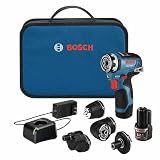
If you need one tool for apartment repairs and flat-pack furniture, start with a drill/driver kit rather than buying several tools at once. A Bosch 12V drill/driver kit is worth comparing with a Milwaukee kit on the total package price. Look for two batteries if you will work for more than a few minutes at a time: one can charge while the other is in use.
If you expect to drive a lot of screws, an impact driver can be useful, but it is not automatically better for every small job. It drives fasteners with less wrist reaction than many drills, yet it is louder and can overdrive small screws or damage soft wood. Use the drill’s clutch for delicate hardware and start at a low setting. Compare a Milwaukee M12 impact driver kit with the equivalent Bosch package, including battery capacity and charger, not just the tool’s advertised output.
For people who already own compatible batteries, tool-only pricing often wins. For a new system, wait for a kit promotion around major holiday sales or seasonal home-improvement events. Check whether a “free tool” offer requires a particular battery bundle, and make sure the included battery capacity suits your work. A low-capacity battery keeps a tool light but may need more frequent charging under heavy use.
Common buying and job-site mistakes
One common mistake is buying the cheapest bare tool without checking what else is required. A charger and battery can erase the apparent savings. Another is choosing the platform based on a single unusually low sale price, then discovering that later tools are expensive or unavailable in the categories you want.
It is also easy to expect compact tools to replace a full-size drill. They are excellent for access and lighter work, but pushing them through repeated heavy drilling can mean slow progress, hot batteries and shorter run time. If the tool gets hot, stalls repeatedly or cannot finish the task without forcing it, stop and change the setup: use a suitable bit, make a pilot hole, take a break or move up to a larger tool.
For occasional small jobs, either brand can be a sound buy. Choose Bosch when its kit is cheaper or you already own Bosch 12V batteries; choose M12 when its wider selection of compact tools is useful to you. If neither ecosystem offers a clear advantage, buy the better-priced kit with the batteries and charger you need, and put the savings toward good bits and fasteners.