How to Find Clearance Tools Without Sacrificing Warranty Coverage
What's inside
As an Amazon Associate I earn from qualifying purchases. This post may contain affiliate links at no extra cost to you.
Clearance Does Not Always Mean Refurbished
A clearance tool may be brand-new, discontinued, open-box, factory refurbished, or simply excess inventory. Those categories matter because the warranty, return period, and included parts can be different even when the discount looks identical.
Start by finding the reason for the markdown. “Discontinued” often means the tool is new but has been replaced by a newer version. That can be a strong value if batteries, chargers, blades, and replacement parts remain available. “Open box” usually means a customer returned it, while “refurbished” means it has been inspected or repaired. “As-is,” “final sale,” and “sold for parts” are warning signs rather than ordinary clearance descriptions.
Before buying, take a screenshot of the listing, price, condition, and warranty language. Retail pages change quickly, and that record can help if the product arrives with missing accessories or a different condition than advertised.
Check the Warranty Before Paying
Do not assume a manufacturer warranty applies just because a tool carries a familiar brand name. Some brands cover clearance tools fully, some exclude refurbished products, and some require purchases through authorized dealers. A retailer’s return policy is separate from the manufacturer’s warranty.
Look for four details:
- Coverage length: Confirm whether the period is measured from the purchase date, shipment date, or original sale.
- Who provides coverage: The retailer may offer a short return window while the manufacturer handles defects afterward.
- Condition exclusions: Used, open-box, factory-reconditioned, and liquidation items may have different terms.
- Registration requirements: Some brands require registration within a stated number of days, and others require an invoice for service.
A warranty generally covers manufacturing defects, not a burned motor caused by a stalled blade, a cracked housing from a drop, water damage, worn brushes, or normal battery capacity loss. Read the exclusions before treating the warranty as insurance against job-site abuse.
Compare the Real Cost, Not Just the Sticker Price
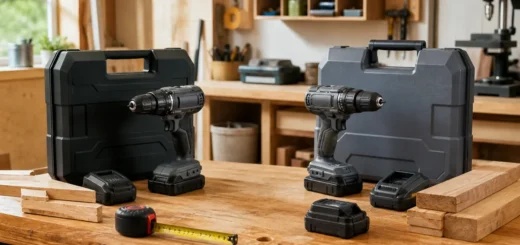
Clearance pricing can be misleading when the tool is sold bare. A discounted cordless drill may still need a battery and charger costing more than the tool itself. Conversely, a corded saw may be a better bargain because it is ready to work immediately and has no battery replacement expense.
| Clearance type | Typical advantage | Main risk | Best check before purchase |
|---|---|---|---|
| New, discontinued | Lowest risk among clearance items | Future batteries or parts may be harder to find | Confirm current battery platform and parts availability |
| Open-box | Often nearly new at a useful discount | Missing accessories or prior misuse | Inspect contents and verify the return window |
| Factory refurbished | Lower price with some inspection behind it | Shorter warranty or cosmetic wear | Read the refurbisher’s warranty and service process |
| Final sale or liquidation | Potentially the lowest price | Little or no recourse after a failure | Avoid unless the price is low enough to accept total loss |
As a practical rule, a clearance item should usually save at least 15% to 20% over an equivalent current model if the warranty is shorter or the return policy is weaker. A 5% discount is rarely worth giving up easy returns. For a $200 tool, a 20% discount saves $40; that can disappear quickly if you must buy a charger, replace a damaged case, or pay shipping for a warranty claim.
Choose Categories That Hold Value
Clearance is safest when the tool has a simple design, strong parts support, and a low failure cost. Corded sanders, grinders, shop vacuums, and basic hand tools can be good candidates because they do not depend on a proprietary battery that may be discontinued. If you only use a drill for occasional household repairs, a discounted corded or entry-level cordless model is often sufficient. Browse corded drills when battery cost would erase the discount.
Battery tools are more attractive when you already own several compatible batteries. Staying within one platform lets you buy a bare tool without duplicating chargers. Before committing, check whether the battery system still includes common sizes and whether batteries are sold individually. A clearance tool that uses an obsolete pack is cheap only until the original battery fails.
For cutting and grinding equipment, inspect the guard, switch, arbor, and included accessories carefully. A missing wrench or guard is not a minor inconvenience if the manufacturer no longer sells that part. For corded angle grinders, a modest discount is usually easier to justify than a discontinued cordless grinder because replacement power is straightforward.
Inspect Open-Box Tools Before the Return Deadline
Test an open-box tool during the first few days, not the night before the return period expires. Check for wobble, unusual noise, heat, arcing, oil leakage, and intermittent switches. Run a drill at low and high speed, cycle the clutch, and verify that the chuck grips a bit without slipping. On a saw, check that the blade sits square and that the guard retracts smoothly.
Look at battery contacts for corrosion or impact marks. A battery that drops from full to empty unusually fast may have been stored flat or heavily used. If the product includes a lithium-ion battery, check for swelling, cracked plastic, or excessive heat during charging. Do not use or charge a visibly damaged pack.
Verify every item against the box label and listing: battery, charger, side handle, guards, wrenches, dust bags, manuals, and cases. Photograph missing or damaged parts immediately. If the retailer offers a 30-day return period, do not wait 29 days to discover that the charger is incompatible.
Time the Purchase Around Product Cycles
Clearance prices often appear when a manufacturer updates a cordless platform, releases a new generation of outdoor equipment, or changes seasonal inventory. Lawn tools tend to be discounted after the main spring and summer selling periods. Space heaters, snow tools, and indoor renovation equipment are more likely to see reductions outside their peak seasons.
Do not buy solely because a yellow sticker says “clearance.” Compare the price with at least one current equivalent, including batteries and accessories. A current model with a two-year warranty and a 90-day return period may be the better value than an older tool discounted by $25.
The safest clearance purchase combines a meaningful discount, a written warranty, a normal return policy, and an active battery or parts ecosystem. If any one of those is missing, demand a lower price—or choose a simpler tool whose failure will not interrupt the job.