Best Affordable Utility Knife for Construction and Workshop Use
What's inside
As an Amazon Associate I earn from qualifying purchases. This post may contain affiliate links at no extra cost to you.
A good utility knife does not need to be expensive. For construction and workshop work, the best value usually comes from a knife with a rigid body, a secure blade lock, quick blade changes, and inexpensive replacement blades. The cheapest folding knife may open cardboard acceptably, but it can become frustrating—or unsafe—when cutting roofing felt, carpet, drywall, plastic strapping, or thick packaging.
As an Amazon Associate we earn from qualifying purchases at no extra cost to you.


What to Look for in an Affordable Utility Knife
Start with the blade system. Standard 2.4-inch utility blades are widely available, and a 100-pack commonly costs about $10 to $20. That keeps the running cost low even when you change blades frequently. A dull blade requires more force, wanders more easily, and is more likely to slip into a hand or nearby material.
For construction, choose a knife with a blade lock that does not depend only on friction. A sliding utility knife should have a positive detent or locking mechanism, while a folding knife should resist closing when pressure is applied to the spine. A metal or reinforced nylon frame generally survives drops and twisting better than a thin plastic shell.
Blade depth adjustment is useful when cutting drywall, vinyl flooring, shingles, or sheet packaging. Exposing only 5 to 10 mm of blade reduces the chance of cutting wires, finished surfaces, or the material underneath. A knife with excessive blade play is a poor choice regardless of its advertised features.
Look for tool-free blade changes if you work through a large amount of material. They save time, but they also need a strong retaining screw or button. A loose quick-change mechanism can release the blade when the knife is pulled from a tool pouch. For occasional box opening, a screw-secured body is slower but often cheaper and more dependable.
Best Budget Utility Knife Types
For general construction, a compact folding utility knife is usually the best balance. It stores safely in a pocket, accepts standard blades, and can be opened with one hand on many designs. It is a good choice for cutting insulation wrap, boxes, housewrap, carpet backing, and plastic strapping. The trade-off is that the hinge and locking mechanism add parts that can collect grit or eventually develop play.
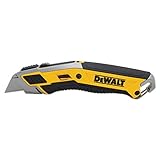
A fixed-body retractable knife is better for dirty work and frequent blade-depth adjustment. It is typically less convenient to carry, but there is no folding hinge to clog. If the knife will live in a tool bag or be used for drywall and roofing materials, a traditional retractable design is often the smarter cheap option. This heavy-duty retractable utility knife category is where basic value is strongest.
For a workshop, a slim snap-off knife can be economical for light cutting, trimming templates, opening cartons, and cutting foam or thin plastic. Its 9 mm or 18 mm segmented blade lets you break off a dull section instead of installing a new blade. It is not the right tool for prying, cutting thick carpet, or forcing through dense roofing materials; the narrow blade can snap under sideways pressure.
| Knife type | Typical price | Best use | Main drawback |
|---|---|---|---|
| Basic retractable | $8–$18 | Construction, boxes, drywall, general repairs | Bulkier and slower to carry |
| Folding utility knife | $12–$30 | Tool belts, pocket carry, frequent blade access | Hinge can collect grit or loosen |
| Snap-off knife | $5–$15 | Workshop trimming and light-duty cutting | Less resistant to twisting and prying |
| Hook-blade knife | $10–$25 | Roofing felt, carpet, shrink wrap | Poor for detailed straight cuts |
The Best Value Choice for Most People
For one knife that handles both a workshop and ordinary construction tasks, buy a folding or retractable model using standard utility blades, priced around $15 to $25. At that price, you can get a metal-reinforced frame, a reliable lock, and storage for one or two spare blades without paying for specialized finishes.
Do not pay extra merely for a magnetic blade holder, elaborate belt clip, or aggressive-looking handle. Those features do not compensate for blade wobble. Put the knife through a simple inspection before buying: open and close it repeatedly, check that the blade locks at each position, and try to move the blade sideways. Any visible movement greater than a small fraction of an inch is a warning sign.
A folding utility knife for standard blades is a sensible middle ground when pocket carry matters. If you rarely carry it and want maximum simplicity, choose a metal retractable knife with blade storage instead.
When the Cheaper Option Is Fine
A $5 to $10 utility knife is perfectly adequate for opening deliveries, cutting tape, trimming cardboard, and occasional household repairs. If it gets used twice a month and is replaced when the slider becomes loose, buying a premium frame is unnecessary. Keep a few spare blades nearby; a cheap knife with a fresh blade is more useful than an expensive knife with a damaged one.
Cheap knives become false economy when they are used daily. Common failure modes include a slider that creeps backward under load, a screw that loosens, a plastic nose that spreads apart, and a blade holder that lets the blade rock sideways. These faults make straight cuts difficult and increase the force required. For daily work, spending an extra $10 to $20 is usually justified.
Blade Cost, Maintenance, and Seasonal Buying
Replacement blades are the consumable that matters most. General-purpose carbon-steel blades are inexpensive and cut aggressively, but they can rust if stored damp. Stainless blades resist corrosion and are useful in garages or humid workshops, though they may cost more and can feel less durable in heavy material. Buy blades in a 50- or 100-pack if you use the knife weekly; small five- or ten-packs usually have the highest per-blade cost.
Use a new blade for long cuts in carpet, roofing membrane, or adhesive-backed flooring. Do not use the knife as a screwdriver or pry bar. Clean dust from the blade channel and tighten retaining screws periodically. If the blade no longer locks firmly, replace the knife rather than trying to compensate by gripping it harder.
Prices often improve around spring renovation sales, Memorial Day, July tool promotions, and Black Friday. The best discounts are frequently on knife-and-blade bundles, but check the blade count and type before comparing prices. A $12 bundle with ten blades may be worse value than a $15 knife with a compatible 100-pack available for $12. For most buyers, purchase the knife during a sale and stock up on standard blades when bulk pricing drops.
For a workshop that handles carpet, roofing material, or heavy shrink wrap, add a hook-blade utility knife and replacement blades rather than forcing a standard pointed blade to do that job. The specialized knife costs a little more, but its blade is less likely to snag the material underneath.