Best Affordable Measuring Wheel for Landscaping and Property Projects
What's inside
As an Amazon Associate I earn from qualifying purchases. This post may contain affiliate links at no extra cost to you.
A measuring wheel is one of the quickest ways to estimate fence runs, planting beds, driveway edges, lawns, and property boundaries. For most landscaping work, you do not need a surveyor’s instrument. A reliable budget wheel with a comfortable handle and a readable counter is usually enough—but the cheapest tool can become frustrating when it skips, loses its count, or folds at the wrong time.
As an Amazon Associate we earn from qualifying purchases at no extra cost to you.



What matters most in an affordable measuring wheel
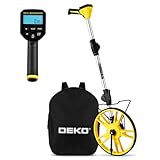
Wheel diameter affects both accuracy and usability. A small 4-inch wheel is easy to store and works well on smooth pavement, garage floors, and short indoor layouts. It tends to bounce or sink into loose soil, mulch, and gravel. A 6- to 8-inch wheel rolls more smoothly over uneven ground and is the better general-purpose choice for yards and property projects.
Look for a mechanical counter that records at least 9,999 feet. Some inexpensive wheels count only in feet; others show feet and inches or feet and tenths. Feet-and-inches displays are easier for common home measurements, while decimal feet can be convenient when entering figures into estimating software. Check the reset button before buying: a stiff or poorly placed reset makes repeated measurements needlessly slow.
The handle should lock firmly at working height and fold without excessive play. A loose telescoping joint can change the wheel angle as you walk, causing the wheel to lift or skid. A pistol-style grip is compact, but a longer handle is usually more comfortable for measuring several hundred feet at a time.
The best budget types for landscaping
| Type | Typical price | Best use | Main compromise |
|---|---|---|---|
| 4-inch compact wheel | $15–$25 | Sidewalks, rooms, short garden layouts | Less stable on grass and gravel |
| 6- to 8-inch single wheel | $20–$40 | Lawns, paths, beds, driveways | Usually has a basic counter and lighter frame |
| 8- to 12-inch contractor wheel | $35–$70 | Frequent property and fence measurements | More expensive and larger to store |
| Digital measuring wheel | $30–$90 | Users who want unit switching and a clear display | Batteries, moisture, and electronics add failure points |
| Dual-wheel model | $45–$100 | Very rough ground and long outdoor runs | Heavier; not always more accurate on narrow paths |
For most homeowners and small landscaping crews, the 6- to 8-inch single-wheel category offers the best value. A 6-inch measuring wheel for landscaping is generally stable enough for grass and inexpensive enough that replacing it after years of occasional use is not painful.
When the cheaper wheel is fine
A $15 to $25 wheel is adequate for measuring a rectangular lawn, estimating mulch, laying out a small garden, or checking the length of a walkway. If the ground is firm and the job is under 100 feet, the accuracy difference between a basic wheel and a contractor model is often insignificant. Walk at a steady pace, keep the wheel vertical, and start with the counter at zero.
The inexpensive option becomes less attractive when you measure rough turf, loose gravel, slopes, or long fence lines. Small wheels can drop into holes and bounce, while light plastic frames may flex when pushed through weeds. A wheel that is nominally accurate can still produce a poor result if it repeatedly loses contact with the ground.
For regular work, spend more on a heavy-duty 8-inch measuring wheel with a metal or reinforced handle, a positive folding lock, and a counter shielded from dirt. These features matter more than a fancy display. A contractor-style wheel may cost $20 to $40 more, but it is less likely to develop wobble or a broken handle after repeated use.
Accuracy, calibration, and common failure modes
Most wheel errors come from technique rather than the printed wheel circumference. Do not tilt the wheel toward yourself. Keep it perpendicular to the surface and follow the actual route, including curves. On a slope, measure along the ground rather than stretching a tape horizontally; that is usually what matters for material quantities and mowing routes.
Before trusting a new wheel, mark a known 100-foot line with a tape measure. Walk it three times in the same direction. If the readings vary by more than about 1 foot, inspect the wheel for slipping, a loose axle, or a counter that is not engaging consistently. A small difference—roughly 1 percent—is normal for ordinary landscaping work. For legal boundary work, drainage elevations, or construction staking, use a surveyor or a more appropriate measuring method instead.
Wet grass can hold mud against the wheel and make it skid. Gravel can wedge between the wheel and frame. After outdoor use, brush off the axle and wipe the wheel clean; do not soak a digital counter. If the wheel has a rubber tread, look for cracking and flat spots. A damaged tread changes the effective diameter and can make every measurement slightly wrong.
Brand value and when to buy
Brand-name contractor tools tend to justify their price with stronger hinges, better counters, and replacement parts—not necessarily dramatically better basic accuracy. For occasional use, a well-reviewed generic wheel is reasonable. For paid landscaping work, the cost of a failed measurement is higher than the initial savings, so a recognizable tool brand with a solid warranty is safer.
Compare the wheel itself, not just the headline price. Shipping can erase a $5 discount, and some listings omit a carrying strap or replacement battery. A professional measuring wheel with replacement parts is worth considering if you measure properties every week.
Prices are often lowest during spring tool promotions, Memorial Day sales, summer outdoor-project events, and November holiday deals. Spring is also when selection is widest, so buy before the landscaping rush if you need a particular wheel size. In late fall, discounts can be good, but inventory may be limited. Avoid paying extra for a digital model unless you specifically need unit conversion or a backlit display; a mechanical counter is simpler to store and ready whenever you need it.
A practical buying checklist
Choose a 6- to 8-inch wheel for mixed lawn, path, and driveway work. Confirm the counter range, display units, handle height, folding-lock design, and wheel tread. If storage space is tight, a compact model is acceptable for paved areas but less useful on turf. If you regularly measure more than 300 feet or work on rough ground, prioritize a rigid frame and larger wheel over digital features.
For a single weekend project, the least expensive wheel that rolls smoothly and resets reliably is enough. For repeated estimates, fence layouts, or paid jobs, the modest upgrade to a sturdier contractor wheel is usually the better value.