Best Rail-Guided Circular Saws for Track-Accurate Cuts
What's inside
- Best Rail-Guided Circular Saws at a Glance
- Plunge Saw vs. Circular Saw on a Rail: What Actually Differs
- Spec Comparison: Leading Dedicated Plunge Saws
- Rail Compatibility: The Detail That Decides Everything
- Decision Matrix: Match Your Situation to a Saw
- Ownership Realities: What Wears and What to Watch
- Verdict
- Related Guides
- Best Rail-Guided Circular Saws at a Glance
- Plunge Saw vs. Circular Saw on a Rail: What Actually Differs
- Spec Comparison: Leading Dedicated Plunge Saws
- Rail Compatibility: The Detail That Decides Everything
- Decision Matrix: Match Your Situation to a Saw
- Ownership Realities: What Wears and What to Watch
- Verdict
- Related Guides
As an Amazon Associate I earn from qualifying purchases. This post may contain affiliate links at no extra cost to you.
Best Rail-Guided Circular Saws at a Glance
If you want track-accurate rip cuts and sheet-goods breakdown without a table saw, rail guided circular saws fall into two camps: dedicated plunge saws with matched tracks (Festool, Makita, DeWalt, Bosch) and standard sidewinder circular saws adapted with universal guide rails or edge guides. For most woodworkers, a dedicated plunge saw with a proprietary rail is the better buy — the blade retracts into the housing for safe mid-panel plunges, and the shoe-to-rail interface is engineered to zero play. A rail-compatible sidewinder makes sense only if you already own the saw and cut sheet goods occasionally.
Plunge Saw vs. Circular Saw on a Rail: What Actually Differs
Five criteria separate the two approaches, and they matter more than brand loyalty:
As an Amazon Associate we earn from qualifying purchases at no extra cost to you.

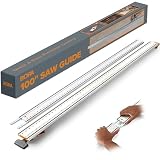


- Track fit: Dedicated plunge saws slide in a machined channel with adjustable glide cams that dial out side play. Sidewinders on universal rails typically clamp or bolt to the rail, which adds setup time and can introduce wobble.
- Plunge control: A plunge saw’s blade drops smoothly into the cut at any point along the rail, essential for cut-outs, flooring, and stopped cuts. A standard circular saw must enter from the material edge and requires a blade-guard hold-back technique that is less safe.
- Splinter protection: Matched rails carry a replaceable rubber splinter strip trimmed by your first cut, giving a chip-free edge on veneers and melamine. Universal rails often include strips too, but aftermarket rails may not seat flush against the blade.
- Cut depth: Plunge saws typically cut 2-1/8 in to 2-5/8 in at 90° (a bit less on the rail). Sidewinders reach similar depths but lose more capacity once mounted to a clamped rail plate.
- Bevel performance: Dedicated saws track cleanly at 45° with minimal drift and often include a -1° undercut setting for scribed edges. Sidewinder bevel cuts on universal rails can deflect because the guard and motor housing shift the shoe’s balance.
Spec Comparison: Leading Dedicated Plunge Saws
| Model | Blade Size | Max Cut Depth @90° (on rail) | Bevel Range | Weight | Power |
|---|---|---|---|---|---|
| Festool TS 55 REQ | 6-1/4 in | 2-1/8 in | -1° to 47° | 9.9 lb | Corded, 1200 W |
| Makita SP6000J | 6-1/2 in | 2-3/16 in | -1° to 48° | 9.7 lb | Corded, 12 A |
| DeWalt DCS520 (FlexVolt 60V) | 6-1/2 in | 2-1/8 in | 0° to 47° | 12.5 lb (with battery) | Cordless, brushless |
| Bosch GKT13-225L | 6-1/2 in | 2-1/4 in | -1° to 47° | 10.4 lb | Corded |
| Standard 7-1/4 in sidewinder + universal rail | 7-1/4 in | ~2-1/4 in effective | 0° to 45°–56° | 9–11 lb | Corded or cordless |
Rail Compatibility: The Detail That Decides Everything
Track ecosystems are partly interchangeable, which buyers rarely learn from listings. The Makita circular saw guide rail and Festool’s FS guide rail share a similar profile — Makita saws run on Festool rails, and most Festool saws run on Makita, Bosch, and Mafell rails with minor glide-cam adjustment. The DeWalt circular saw and guide rail pairing uses DeWalt’s dual-edged track, which is cuttable from both sides but is not cross-compatible with Festool-style rails. If you search for a DeWalt circular saw guide rail, note that DeWalt’s 60V plunge saw (DCS520) is the model designed for their track; standard DeWalt sidewinders need third-party adapter plates.
Universal circular saw guide rail systems — clamp-style straightedges and adapter bases that bolt under a sidewinder’s shoe — work with nearly any brand, but expect a learning curve. The adapter must be squared to the blade, and the sled adds height, cutting effective depth by roughly 1/4 in to 1/2 in.
Decision Matrix: Match Your Situation to a Saw
| Your situation | Best choice | Why |
|---|---|---|
| Breaking down plywood/melamine weekly, cabinet or furniture work | Dedicated plunge saw + two rails (55 in and 75 in) | Splinter-free edges, fast repeatability, plunge entries |
| Occasional sheet goods, already own a quality sidewinder | Universal guide rail with adapter sled | Lowest cost; accept slower setup and edge-entry only |
| Jobsite use away from power | Cordless plunge saw (DeWalt FlexVolt or Makita 36V/40V) | No cord over sheet goods; battery runtime covers a day’s rips |
| Flooring, cut-outs, and sink openings | Dedicated plunge saw only | Mid-panel plunge is the core capability; sidewinders can’t safely do it |
| Tight budget, first workshop | Value-brand plunge saw kit (often 30–50% less than premium) | Compatible clones of the Festool rail standard exist; verify fit |
Ownership Realities: What Wears and What to Watch
- Splinter strip: The rubber strip is a consumable. Each blade or bevel change trims a new edge; replace strips yearly with heavy use.
- Glide cams: Re-check shoe play every few months. A quarter-turn on the adjustment cams restores a zero-slop fit.
- Track clamps: Rails still slip on slick surfaces — use track clamps or non-slip pads for finish work; don’t trust friction strips alone.
- Blades: A 48-tooth fine blade ships with most saws; swap to a 24-tooth rip blade for thick hardwood or you’ll burnish cuts and strain the motor.
- Common mistake: Buying a single 55 in rail and discovering 8-ft sheet goods needs a 110 in run. Budget for the longer rail or a connector kit up front.
Verdict
For anyone cutting sheet goods more than a few times a month, buy a dedicated plunge saw matched to the Festool/Makita rail standard — the Makita SP6000J for value, Festool TS 55 for refinement, DeWalt DCS520 for cordless. Keep a sidewinder plus universal guide rail only as a budget or backup solution. The rail ecosystem matters more than the saw itself, so choose the track standard first and the saw second.