Best Laminate Jigsaw Blades for Chip-Free Cuts
What's inside
- Best Laminate Jigsaw Blades for Chip-Free Cuts
- Reverse-tooth vs. fine-TPI blades
- How to choose laminate jigsaw blades by situation
- Blade length and tooth pitch matter more than marketing names
- Cutting direction: face up or face down?
- How to make a chip-free laminate cut
- Techniques for flooring, countertops, and panels
- Ownership realities: when to replace the blade
- Bottom line
- Related Guides
- Best Laminate Jigsaw Blades for Chip-Free Cuts
- Reverse-tooth vs. fine-TPI blades
- How to choose laminate jigsaw blades by situation
- Blade length and tooth pitch matter more than marketing names
- Cutting direction: face up or face down?
- How to make a chip-free laminate cut
- Techniques for flooring, countertops, and panels
- Ownership realities: when to replace the blade
- Bottom line
- Related Guides
As an Amazon Associate I earn from qualifying purchases. This post may contain affiliate links at no extra cost to you.
Best Laminate Jigsaw Blades for Chip-Free Cuts
The best laminate jigsaw blade for a clean, visible surface is usually a reverse-tooth, fine-cut blade used with the orbital action switched off; choose a conventional fine-tooth blade instead when you can cut with the finished face downward.
Laminate is difficult to cut cleanly because its decorative top layer is hard and brittle, while the core may be fiberboard, particleboard, or a layered countertop material. A blade can pass through the core smoothly and still chip the surface as its teeth exit. The right choice depends less on the jigsaw brand than on tooth direction, tooth pitch, blade length, and how the workpiece is supported.
As an Amazon Associate we earn from qualifying purchases at no extra cost to you.


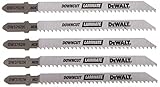

Reverse-tooth vs. fine-TPI blades
| Blade type | Typical specification | Best cutting direction | Best use | Main drawback |
|---|---|---|---|---|
| Reverse-tooth laminate blade | 75–100 mm overall length; 10–12 TPI; teeth point downward | Finished face up | Installed flooring, countertops, and panels that cannot be turned over | Slower feed rate and more vibration if the shoe is not firmly supported |
| Fine-tooth conventional blade | 75–100 mm overall length; 12–20 TPI; teeth point upward | Finished face down | Loose boards, cabinet panels, and straight cuts where the workpiece can be flipped | Chips the top surface if used face-up |
| Down-cut laminate blade | 75–100 mm overall length; approximately 10–12 TPI | Finished face up | Short, controlled cuts in thin laminate sheets | Can pack dust into the cut and cut slowly in thick material |
| Standard coarse wood blade | 75–100 mm overall length; 6–10 TPI | Face down only for acceptable appearance | Hidden cuts or fast rough sizing | Usually produces visible chips and breakout |
Reverse-tooth laminate blades are the safest choice when the finished surface must face upward. Their downward-cutting teeth tend to press the decorative layer against the workpiece rather than lifting it. Bosch’s T101BR is a well-known example of this blade style, although equivalent reverse-tooth blades from other established tool manufacturers can work just as well when their length and shank fit your jigsaw.
A conventional fine-TPI blade can produce an equally good or better result when the finished face is placed downward. The jigsaw’s normal upward-cutting action then exits through the less important underside. This approach is often preferable for long flooring cuts because conventional blades generally track more predictably than reverse-tooth designs.
How to choose laminate jigsaw blades by situation
| Your situation | Recommended choice | Why |
|---|---|---|
| One repair or small flooring project | One reverse-tooth blade plus one spare | Minimal cost while protecting visible edges |
| Frequent flooring installation | Pack of fine conventional blades and reverse-tooth blades | Use face-down cuts when possible and reserve reverse blades for installed boards |
| Beginner cutting a countertop opening | Reverse-tooth, 10–12 TPI blade with orbital action off | Forgives the face-up cutting position and reduces aggressive chipping |
| Thin laminate panel under 6 mm | Fine 16–20 TPI down-cut or reverse-tooth blade | Smaller teeth reduce the tendency to tear the thin surface |
| Thick laminate-covered board from 18–30 mm | 10–12 TPI reverse-tooth blade or fine conventional blade | Provides enough gullets to clear the core without becoming excessively aggressive |
Blade length and tooth pitch matter more than marketing names
For most laminate flooring and cabinet panels, a blade with an overall length of 75 to 100 mm is sufficient. The cutting capacity printed on the package is more important than overall length: leave at least 10 mm of tooth length below the material during the stroke. A blade that barely clears the workpiece can overheat, wander, or pull sideways.
For a 12 mm laminate board, a blade with 20–30 mm of usable tooth length is normally adequate. For a 30 mm countertop, choose a longer blade and check the manufacturer’s stated wood-cutting capacity. Do not assume that a 100 mm blade can cut 100 mm of material; part of its length is held in the clamp and part remains above the workpiece during the stroke.
Tooth pitch is a balance. Fine teeth, around 16–20 TPI, leave a smoother edge in thin sheet material but remove dust more slowly. Blades around 10–12 TPI are more versatile for flooring and thick panels. Coarse blades remove material quickly but are much more likely to chip the melamine or laminate layer.
Cutting direction: face up or face down?
- Conventional upward-cutting blade: place the decorative face downward whenever the design of the cut allows it.
- Reverse-tooth or down-cut blade: place the decorative face upward, especially for an installed floorboard or fixed countertop.
- Unsure about the blade: inspect the teeth from the side. The cutting points should normally face upward on a standard blade and downward on a reverse-tooth blade.
Always make a short test cut in a scrap offcut from the same material. Laminate finishes vary, and a blade that is clean on one manufacturer’s flooring may leave small chips on another product with a harder overlay.
How to make a chip-free laminate cut
1. Mark the waste side
Mark the line on painter’s tape rather than directly on the decorative surface. Extend the line beyond the entry and exit points so the blade does not have to start or stop on the finished edge. Leave the correct expansion gap for flooring or the manufacturer’s required clearance around a countertop opening; a perfectly clean cut is not useful if the part is the wrong size.
2. Support the material continuously
Place the panel on a level sacrificial surface and support both sides of the cut. Unsupported laminate can flex, which causes the blade to lift the surface layer on every stroke. When cutting a loose flooring plank, clamp it close enough to the line to prevent movement but not so tightly that the board bows.
3. Turn off orbital action
Set the jigsaw’s pendulum or orbital setting to zero. Orbital movement makes the blade travel forward on the return stroke, improving speed in soft wood but increasing breakout in laminate. Use a moderate speed rather than the maximum setting, particularly with a reverse-tooth blade or thin sheet.
4. Let the blade do the cutting
Feed steadily without forcing the saw. Excessive pressure bends the blade and can make a straight line curve when the pressure is released. If the cut begins to smell hot, slows noticeably, or produces melted-looking resin, reduce pressure, improve dust clearance, or replace the blade.
5. Use a guide for long cuts
Clamp a straightedge parallel to the cut line and account for the distance between the blade and the jigsaw shoe. A guide prevents the sideways corrections that commonly create chipped sections. Keep the shoe flat on the surface throughout the cut, especially with reverse-tooth laminate blades, which can lift the saw if the operator starts too quickly.
Techniques for flooring, countertops, and panels
Flooring: For a loose plank, face-down cutting with a fine conventional blade is usually efficient. For a plank already fitted against a wall or doorway, use a reverse-tooth blade face up. Masking tape over the cut line can provide additional surface support, but it is not a substitute for the correct tooth direction.
Countertops: A reverse-tooth blade is useful for sink and cooktop openings because the finished surface remains visible. Drill starter holes larger than the blade at inside corners, then cut between the holes. Do not force the blade around a tight corner; a relief hole prevents the laminate from cracking at the corner.
Laminate-covered panels: Clamp the panel to a sacrificial board and use a fine blade. If both faces must remain visible, make the cut slightly proud and finish the edge with a fine file, sanding block, or suitable edge trim. Sand from the laminate side toward the core to avoid lifting the decorative layer.
Ownership realities: when to replace the blade
The teeth usually wear before the blade body fails. Replace a blade when it requires increasing pressure, leaves a wider or rougher kerf, starts wandering, or discolors the laminate. A sharp blade is often cheaper than repairing a chipped countertop edge. For a small project, two or three blades may be enough; abrasive overlays, high-pressure laminate, and dense countertop cores can consume blades faster than ordinary flooring.
After cutting, unplug a corded jigsaw or remove the battery from a cordless model before clearing dust. Brush debris from the shoe and blade clamp, and use a vacuum or low-pressure air to keep laminate dust from packing around the guide mechanism. Store unused blades in their package so fine teeth do not contact loose screws or other tools.
Bottom line
Choose reverse-tooth laminate jigsaw blades for face-up cuts where the finished surface cannot be turned over. Choose a 12–20 TPI conventional fine blade for face-down cuts on loose flooring and panels. In either case, use a blade long enough to clear the material, switch orbital action off, support the workpiece, and make a test cut before committing to the visible edge.