Best Affordable Tools for a Home Workshop Focused on Handcrafts
What's inside
As an Amazon Associate I earn from qualifying purchases. This post may contain affiliate links at no extra cost to you.
A small handcraft workshop does not need a wall of power tools. For carving, sewing, jewelry work, model-making, small repairs, and mixed-material projects, a few dependable hand tools usually do more useful work than a pile of bargain gadgets. Spend first on tools that affect accuracy and safety; save on accessories that are easy to replace.
Prices below are approximate U.S. street-price ranges, not live quotes. They shift with sales, shipping, and quality. For budget tools, inspect the actual item when possible: loose handles, uneven jaws, and blades that will not hold an edge can turn a low price into a false economy.
As an Amazon Associate we earn from qualifying purchases at no extra cost to you.



Start with the bench and basic measuring tools
A stable work surface is the foundation. A used solid-wood table or a basic workbench often beats a lightweight folding table, which can rack or bounce when you saw or chisel. If the top is narrow, clamp a sacrificial board to it for drilling and cutting. Add a bench hook for hand-saw work and a nonslip mat for small parts; these are inexpensive ways to control a workpiece without buying a large vise.
Buy a steel rule, a combination square, and a marking knife or sharp pencil before adding specialized tools. A $10–$20 rule and a $15–$30 square are adequate for most craft projects if their edges are straight and the square reads accurately. Check a square by drawing a line along its stock, flipping it, and drawing another line on the same edge. If the lines diverge, it is not trustworthy for layout.
For small assemblies, a pair of spring clamps and two or four bar clamps cover many jobs. Inexpensive clamps are fine for holding a template or keeping a piece still. For glue-ups, weak clamp bars can bow and leave uneven pressure; test them before relying on them, and do not compensate by overtightening a fragile project.
Where budget tools make sense
The best-value choice depends on how often a tool is used and how much a bad result costs. A beginner can start with serviceable entry-level tools, then upgrade the one that causes repeated frustration. The ranges below are typical for basic, nonprofessional options.
| Tool or category | Budget range | Spend more when | Common budget failure |
|---|---|---|---|
| Combination square | $15–$30 | You lay out joints or repeat measurements often | Blade slips or is not square to the stock |
| Hand saw | $15–$35 | You need clean, repeatable cuts in hardwood | Blade wanders or teeth dull quickly |
| Clamps, set of 2–4 | $15–$40 | You glue larger pieces or need reliable pressure | Bars flex; pads mark soft wood |
| Rotary tool with basic accessories | $25–$60 | You use it regularly for detail work | Runout, vibration, or poor accessory fit |
| Sharpening supplies | $15–$50 | You use chisels, carving tools, or knives weekly | Cheap stones dish or clog; unclear grit quality |
Brand reputation can help, but it is not a substitute for checking fit and finish. A familiar brand’s entry-level line may be better supported with replacement parts, while a no-name set may offer more pieces for the same price but inconsistent quality. For hand tools, one accurate square or usable chisel is worth more than a large set with several tools you will not use.
Choose cutting and shaping tools for your materials
For wood, a sharp utility knife, a small backsaw, and one or two chisels cover a surprising amount of handcraft work. A basic saw in the $15–$35 range is reasonable for occasional cuts. Check that the handle is secure and the blade tracks straight. If you regularly cut hardwood or need tight joinery, a better saw can save time and reduce tear-out; if you mainly cut softwood or craft stock, the budget option is often enough.
For mixed materials and detailed shaping, a variable-speed rotary tool kit can be useful for sanding, engraving, and light trimming. It is not a substitute for a saw or a proper drill. Very cheap units may vibrate, heat up during extended use, or have collets that grip accessories poorly. Keep pressure light, use the correct accessory, and wear eye protection; a small abrasive wheel can break if forced sideways.
For cutting fabric, leather, or paper, buy scissors suited to the material rather than a multipurpose bargain set. Fabric shears in the $15–$30 range are fine for home use if kept for fabric only. Cutting paper or wire with them can quickly blunt the edge. For leather, a sharp utility knife and a cutting mat are often better value than specialized powered equipment.
Drilling, finishing, and safety on a budget
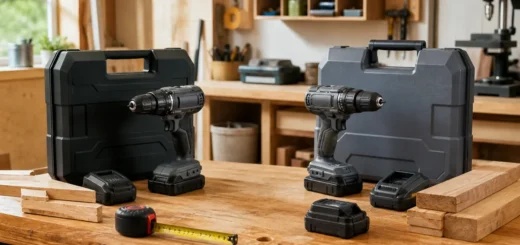
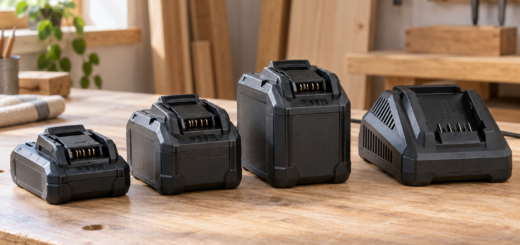
A corded drill is often the better bargain for an occasional workshop: it avoids battery replacement costs and is ready whenever there is an outlet. A cordless drill is more convenient for jobs away from the bench, but compare the price of the tool, battery, and charger together. A drill with a clutch and variable speed is more useful for craft assembly than the cheapest single-speed option, which can strip small screws or split thin stock. Pair it with a basic set of quality bits rather than buying a large assortment of soft metal bits.
For sanding, a sanding block and sheets in 80, 120, and 180 grit handle many small projects. A cordless drill-driver kit with battery and charger is worth considering if portability matters; check whether the advertised kit includes both, since bare tools can look cheaper. A random-orbit sander is convenient for larger surfaces, but it creates fine dust and is unnecessary for tiny pieces that a block can finish just as well.
Do not economize on eye protection, a dust mask suited to the material, or hearing protection when using powered tools. A basic pair of safety glasses is inexpensive; a paper mask may not be adequate for prolonged sanding or irritating dust. Ventilate when using finishes, follow the product label, and keep oily finishing rags in a sealed metal container or laid flat outdoors to dry—bunched-up oil-soaked rags can heat and ignite.
Buy by need, then watch the calendar
Make a short list of projects and buy for the next two or three, not an imagined future shop. A $20 tool used every week can be better value than a $100 tool used once. Before buying a kit, check replacement blades, bits, and consumables: a cheap tool that accepts common accessories may cost less over time than a discounted proprietary system.
Seasonal sales can help, but compare the full price and included accessories. Spring home-improvement promotions and major holiday sales often reduce prices on drills, sanders, and clamp sets; clearance can be useful for hand tools and storage. Avoid buying a large bundle just because the per-piece price looks low. If only two items are usable, the bundle was not a bargain. For handcraft work, a small, accurate, repairable setup is usually the affordable choice—not the one with the most tools.