Best Affordable Gas Pressure Washer for Driveways and Decks
What's inside
As an Amazon Associate I earn from qualifying purchases. This post may contain affiliate links at no extra cost to you.
What to Look for in an Affordable Gas Pressure Washer
For driveways and decks, a gas pressure washer in the 2,500 to 3,200 PSI range with 2.3 to 2.7 gallons per minute (GPM) is the practical budget target. That combination provides enough cleaning power for concrete, pavers, and outdoor furniture without moving into commercial pricing.
PSI measures pressure, while GPM measures water volume. A machine with high PSI but weak flow can feel slow on a large driveway. For most homeowners, cleaning power around 6,000 to 8,000 cleaning units (PSI multiplied by GPM) is a better value than chasing the highest advertised pressure.
As an Amazon Associate we earn from qualifying purchases at no extra cost to you.


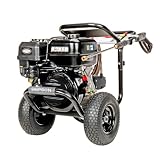
Look for a four-stroke engine, a welded or sturdy frame, 10-inch or larger wheels, and a pump that can be serviced or replaced. A fold-down handle helps with storage, but flimsy plastic fittings and small wheels are more serious concerns. They make the washer harder to move and more likely to leak or tip on uneven ground.
A useful starting point is this selection of 2,500–3,200 PSI gas pressure washers. Prices change throughout the year, so compare the pump rating, hose length, and included nozzles rather than relying only on the headline PSI.
Best Value Specifications by Job
| Job | Useful pressure | Useful flow | Notes |
|---|---|---|---|
| Concrete driveway | 2,800–3,200 PSI | 2.5–3.0 GPM | Faster cleaning; use a surface cleaner |
| Wood deck | 1,500–2,400 PSI | 2.0–2.5 GPM | Lower pressure prevents gouging |
| Pavers and brick | 2,500–3,000 PSI | 2.3–2.7 GPM | Watch for loose joint sand |
| Patio furniture and siding | 1,500–2,500 PSI | 1.8–2.5 GPM | Wide spray pattern is more important |
For a mixed-property machine, about 3,000 PSI and 2.5 GPM is the sensible middle ground. You can reduce the effective force by using a wider nozzle, standing farther away, or using a pressure-control valve. You cannot safely make a poorly designed machine deliver more water, so flow is often the more valuable specification once pressure is adequate.
Budget, Midrange, and Brand Value
The cheapest gas washers often cost roughly $200 to $280 during sales. They can be fine for one or two driveway cleanings per year, especially if the unit has a common horizontal-shaft engine and a basic axial-cam pump. The trade-off is usually a shorter hose, more vibration, less consistent quality control, and a pump that may not be economical to replace.
In the roughly $300 to $450 range, you are more likely to get a better hose, stronger wheels, a detergent tank that actually works, and a pump with better parts availability. This is the range where brand value matters most. Established engine brands are generally safer bets for starting reliability, while established pressure-washer brands may offer better frames, accessories, and warranty support. Check which company covers the engine and which covers the pump; they are often different warranties.
Machines above $500 can make sense for frequent cleaning, large properties, or rental-like use. They are not automatically better for a homeowner. A premium engine attached to a low-grade pump still leaves you with a pump problem. Unless you clean several times each season, spend first on flow rate, hose quality, and a replaceable pump rather than decorative features.
For the lowest reasonable purchase price, compare budget gas pressure washers under 3,000 PSI. A cheaper unit is acceptable when the work is occasional and you are willing to winterize it carefully. It is a poor bargain if the washer will sit outdoors, be used weekly, or clean a long driveway every month.
How to Clean Driveways and Decks Without Damage
On concrete, pre-treat oil stains with a concrete-safe degreaser and let it dwell according to the label. Use a 25-degree nozzle for general cleaning and keep it moving. A surface cleaner is a worthwhile upgrade because it keeps the spray height consistent, reduces striping, and is usually much faster than sweeping a wand back and forth. For a 3,000 PSI machine, choose a surface cleaner rated above the washer’s pressure and matched reasonably to its GPM.
Do not hold a narrow nozzle close to concrete for long. It can etch soft concrete, expose aggregate, or leave visible tracks. Start 12 to 18 inches away and move closer only if the surface tolerates it. A driveway that looks uniformly clean while wet can show zebra stripes after it dries, so overlap each pass by several inches.
Deck boards require more restraint. Use a 40-degree nozzle or a low-pressure tip, begin at least 18 inches away, and follow the grain. Never stop the spray on one spot. A pressure washer can cut grooves into pine or cedar in seconds, and those grooves will hold dirt and stain unevenly. On composite decking, follow the manufacturer’s pressure limits; some boards can be scarred by concentrated spray even when they look durable.
Common Failure Modes and Ownership Costs
The most common failure is stale fuel blocking the carburetor after winter storage. Use fresh fuel, shut off the fuel valve if fitted, and run the carburetor bowl dry before storage. Stabilizer helps, but it does not repair fuel that has already degraded. Store the washer where freezing water cannot remain in the pump, and use pump antifreeze or the manufacturer’s winterizing procedure in cold climates.
Never run the machine without a water supply connected. A few seconds of dry operation can damage the pump. Avoid leaving the engine running while the trigger is released for long periods; recirculating hot water can overheat an axial pump. Pull the trigger every minute or so, or shut the engine off during pauses.
Seasonal sales are usually strongest in spring, around Memorial Day, and late summer when stores clear outdoor equipment. Fall discounts can be excellent, but inspect the box for missing accessories and confirm that the warranty is still valid. Before buying, price a replacement hose, nozzle set, and pump. If those parts cost nearly as much as the washer, the bargain is probably disposable rather than economical.