Best Budget Pressure Washer for Cleaning Patios and Driveways
What's inside
As an Amazon Associate I earn from qualifying purchases. This post may contain affiliate links at no extra cost to you.
What matters for patios and driveways
For routine cleaning, a budget electric pressure washer is usually enough for a patio, garden path, or a small driveway. It costs less to run and maintain than a gas washer, starts with a switch, and is easier to store. The trade-off is slower work: a small electric unit may need to be moved between outlets, and its advertised pressure does not tell you how quickly it will clean.
Look at pressure and flow together. Pressure, measured in PSI, helps loosen dirt; flow, measured in gallons per minute (GPM), carries it away. For light home use, a practical target is roughly 1,700–2,000 PSI and 1.2–1.6 GPM. Manufacturers’ figures are often maximum or “peak” ratings, not what the machine delivers continuously. Compare operating figures when they are available, and treat headline PSI as a rough guide rather than a promise of cleaning speed.
As an Amazon Associate we earn from qualifying purchases at no extra cost to you.


Best value: a basic electric washer
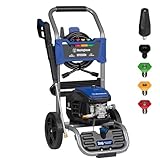
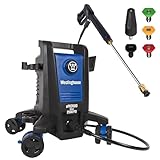
A basic electric washer with a detergent tank, a reasonably long high-pressure hose, and standard quick-connect nozzles is the best starting point for most homeowners. The electric pressure washers around 2,000 PSI are worth comparing if you want one machine for seasonal patio and driveway cleanup. Compare included accessories as well as price: a short hose or missing inlet filter can make a cheap unit frustrating.
For a small paved area cleaned once or twice a year, a lower-priced electric model can be perfectly adequate. Expect to work in overlapping passes and take your time on embedded grime. A pricier unit may be worthwhile if it offers more flow, a better hose, easier storage, or a useful surface cleaner—not simply a larger pressure number on the box.
Budget washer types compared
| Type | Typical use | Main advantage | Trade-off |
|---|---|---|---|
| Compact electric | Small patio, walkway, light dirt | Lowest cost and easy storage | Slower on large areas; limited hose reach |
| Mid-range electric | Patio and occasional driveway cleaning | Good balance of flow, reach, and price | Still needs a power outlet and water supply |
| Gas washer | Large areas or frequent heavy-duty work | More mobility and often higher output | Higher purchase and upkeep costs, noise, fuel, and exhaust |
For an ordinary suburban driveway, mid-range electric is often the sensible budget choice. Consider gas only if you regularly clean large areas, lack practical access to power, or need output that electric models cannot provide. Gas power is not automatically better for concrete: an overly aggressive tip or close pass can etch the surface regardless of what powers the machine.
The accessory that can save time
A surface cleaner is a round attachment with spinning jets underneath. It can cover concrete more evenly than a narrow nozzle and reduce the striped appearance that comes from inconsistent wand passes. If your budget allows, compare a surface cleaner sized for an electric pressure washer with a washer bundle that includes one. Check the attachment’s required pressure and flow; an undersized washer may spin it poorly or clean slowly.
It is not essential for a small patio, and a cheap accessory is not always a saving if it is incompatible or flimsy. Check the connection type, supported PSI and GPM, and the manufacturer’s recommended washer range. For a few hundred square feet of concrete, the time saved can matter more than a modest difference in motor rating.
Clean without damaging the surface
Start with the broadest nozzle supplied, commonly a 25-degree tip, and test an inconspicuous patch. Keep the wand moving and begin several inches above the surface; adjust distance only after checking the result. Avoid a zero-degree tip on concrete, pavers, wood, or painted surfaces. It concentrates force into a small spot and can cut lines into concrete, blast joint sand from pavers, or scar softer materials.
Clear loose debris first, protect nearby plants, and keep the spray away from people, pets, electrical fittings, and fragile edges. Use detergent only if the washer and surface allow it, and follow the label’s dilution and rinse instructions. Do not assume more pressure will remove oil stains: some need a suitable degreaser and dwell time, and old stains may remain even after washing.
On pavers, avoid directing the jet into joints. On older or cracked concrete, aggressive cleaning can widen damage or expose weak aggregate. If your patio has delicate stone, a failing surface coating, or loose pointing, hand cleaning or a lower-pressure approach may be safer than using a washer.
When and how to buy
Compare prices in late winter and early spring, when retailers begin promoting outdoor equipment, and again near the end of the main gardening season. A seasonal discount is useful only if the package includes the accessories you need and the washer has a clear warranty and available replacement parts. Check hose length, cord length, inlet filter, nozzle set, and storage setup before treating a low sticker price as good value.
Buy the least expensive washer that suits the size and condition of your surfaces. For occasional cleaning on a small patio, a basic electric machine is fine. For a longer driveway or regular use, prioritize flow, hose reach, and a compatible surface cleaner. If you only need to wash one modest area, renting a stronger machine may cost less than buying and storing one you rarely use.
Make a budget washer last
Before use, connect the water supply and let water flow through the washer until air is purged, following the manual. Running a pump dry can damage it. Clean the inlet filter, avoid kinking the hose, and never pull the machine by its pressure hose. After use, disconnect and drain the hoses as directed; in freezing weather, store the unit where water inside the pump cannot freeze.
These simple steps matter more than paying extra for a feature you will not use. A modest electric washer handled within its limits can clean ordinary patio and driveway grime for years; forcing it to do heavy commercial work is where the budget choice tends to disappoint.