Best Affordable Workbench for a Small Utility Room
What's inside
As an Amazon Associate I earn from qualifying purchases. This post may contain affiliate links at no extra cost to you.
A small utility room does not need a professional cabinetmaker’s bench. It needs a stable work surface, enough depth to use tools without knocking parts onto the floor, and storage that does not consume the entire room. For most homeowners, the best affordable workbench is a compact steel or laminated-wood bench in the 36- to 48-inch range, preferably with an adjustable lower shelf.
Expect to spend about $80 to $180 for a basic bench and $180 to $300 for a sturdier model with drawers, a vise, or a thicker top. The cheapest choice can be perfectly adequate for repairs, sharpening, potting, and light assembly. It becomes a poor bargain when the frame flexes, the top swells, or the bench walks across the floor under modest pressure.
As an Amazon Associate we earn from qualifying purchases at no extra cost to you.


What matters in a small utility-room workbench
Depth is the first constraint. A 20- to 24-inch-deep bench gives you usable room for a vise, drill, small saw, and parts tray without projecting too far into a walkway. Benches under 18 inches deep save space but feel cramped quickly. Measure the room with doors, appliances, and access panels open. Leave at least 30 inches of clear working space in front if possible.
Width affects both productivity and fit. A 36-inch bench fits many utility rooms and is enough for small repairs. A 48-inch bench is a better value if the wall allows it, because tools and materials can stay laid out. Avoid buying a 60-inch bench simply because it is on sale; a crowded room makes every job harder.
Look for a load rating of at least 300 pounds. That rating is usually more than enough for household work, but it also suggests a more rigid frame. Do not assume the rating means the top will remain flat under that weight. A thin particleboard surface can sag even when the legs are rated for several hundred pounds.
Height should match the work. Around 34 to 36 inches suits general assembly and hand-tool work. A 30-inch bench can be more comfortable for seated tasks, while a 38-inch bench is useful for standing detail work. Fixed-height benches are cheaper, but adjustable feet are valuable on uneven utility-room floors.
The best affordable bench types
A compact steel workbench with an adjustable shelf is the safest general recommendation. Steel legs resist racking, the shelf holds a toolbox or shop vacuum, and the top can be replaced or covered later. These benches commonly cost $90 to $170. Check that the legs use bolted cross braces rather than relying on thin stamped panels.
A laminated-wood workbench is usually quieter and more pleasant for assembly. It can also accept screws more easily than a thin steel top. At the low end, however, “wood” may mean a 5/8-inch particleboard panel. That is fine for sorting hardware and light repairs, but it can chip around a vise and swell permanently after a leak.
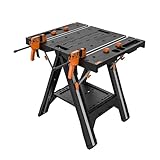
A folding workbench makes sense when the utility room must remain flexible. It is easy to store and often costs $50 to $120. The trade-off is stiffness: folding hinges and narrow feet can shift while you plane, sand, or tighten a stubborn fastener. Choose one with locking legs and a stated load rating of at least 300 pounds. It is a good occasional-use option, not the best permanent bench.
A workbench with built-in drawers is worth considering only when you lack another place for hand tools. Drawers add cost and reduce legroom. In inexpensive benches, drawer slides may bind when the cabinet is not perfectly level. A basic bench plus a separate tool tote is often cheaper and easier to rearrange.
Affordable workbench comparison
| Type | Typical price | Best use | Main weakness |
|---|---|---|---|
| Steel frame with shelf | $90–$170 | General repairs and storage | Can flex if cross-bracing is poor |
| Laminated-wood top | $100–$220 | Assembly and hand tools | Low-grade tops swell or sag |
| Folding workbench | $50–$120 | Temporary or occasional work | Less stable under side loads |
| Drawer-equipped bench | $180–$300 | Tool storage in one unit | Higher cost and limited drawer quality |
Top thickness, vise mounting, and durability
For general utility-room work, a top between 1 and 1.25 inches thick is a sensible target. A thinner top is not automatically unusable, but it needs support underneath every 16 to 24 inches to avoid bouncing. If you plan to install a bench vise, choose a top at least 1 inch thick and verify that the frame underneath allows through-bolts. Clamps alone can pull loose when you apply torque.
Many inexpensive benches advertise a vise but include a small, light-duty unit. That is useful for holding a pipe fitting or small piece of wood, not for bending steel or loosening seized fasteners. If the included vise is flimsy, a 4-inch bench vise with a swivel base is a practical upgrade. Budget roughly $35 to $80, and reinforce the mounting area with a hardwood or plywood plate if the top is thin.
Utility rooms are often damp or exposed to cleaning chemicals. Powder-coated steel generally handles that environment better than unfinished mild steel. For wood tops, seal all edges with polyurethane or paint, especially the underside and screw holes. Keep the bench away from a water heater’s relief-valve discharge path and do not block furnace or electrical-panel access.
How to buy at the lowest sensible price
Compare the delivered price, not the headline price. A $90 bench with $35 shipping may cost more than a $120 model sold locally. Also check what the package includes: some listings show a vise, pegboard, or drawers in photographs but sell only the frame and top.
Seasonal sales are most common around spring home-improvement promotions, summer garage-sale season, and November holiday events. Prices on basic benches often move by $15 to $40, so track the exact dimensions and model rather than trusting a large percentage-off label. Local hardware stores can be the better deal when a damaged-box unit is available; inspect the top for warping and confirm all braces and fasteners are included.
If the cheapest bench meets your needs, buy it—but budget for upgrades. Four rubber leveling feet, a sacrificial 3/4-inch plywood top, and wall anchoring can turn a $90 bench into a much more useful station. Anchor the rear frame to studs whenever children, pets, or heavy tools could pull on it. If the bench rocks after assembly, do not compensate by stacking shims under one leg and ignoring loose bolts; square the frame, tighten every joint, and level it properly.
For most small utility rooms, a 36- to 48-inch steel-frame bench with a 20-inch-plus depth, adjustable feet, and a replaceable top offers the strongest value. Choose folding only when storage flexibility matters more than rigidity, and pay extra for drawers only when they replace a separate cabinet you would otherwise need.