Best Budget Cordless Drill for Hanging Shelves and Assembling Furniture
What's inside
As an Amazon Associate I earn from qualifying purchases. This post may contain affiliate links at no extra cost to you.
For hanging shelves and assembling furniture, the best budget cordless drill is not the one with the highest advertised voltage or the biggest battery. It is a compact drill with a usable clutch, a two-speed gearbox, and enough torque to drive screws without stripping them or crushing particleboard. For most homes, a basic 12V or 18V/20V drill-driver is enough.
As an Amazon Associate we earn from qualifying purchases at no extra cost to you.



What matters for shelves and furniture
A drill-driver is the right tool for this work. Do not pay extra for an impact driver unless you regularly drive long construction screws. Impact drivers are powerful, but their hammering action makes them easier to overdrive screws, damage cabinet hardware, and split thin wood.
Look for a keyless chuck measuring 3/8 or 1/2 inch, a two-speed selector, and at least 15 clutch settings. The clutch is important because it stops the chuck when a screw reaches a chosen resistance. That helps prevent stripped screw heads and screws buried below the surface of a flat-pack panel.
For furniture assembly, a compact 12V drill is usually the easiest option. It is lighter, less tiring, and less likely to damage softwood or engineered board. For wall shelves, an 18V or 20V drill gives more reserve power for drilling studs and driving longer screws. Voltage labels are not a direct measure of performance: 18V and 20V tools are generally the same battery class, with 20V commonly being the maximum voltage rating.
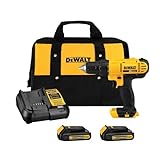
A good starting point is a 12V cordless drill-driver kit for furniture, or an 18V or 20V cordless drill-driver kit if shelves and general repairs are also on your list.
Budget drill categories compared
| Type | Typical kit price | Best use | Main compromise |
|---|---|---|---|
| Basic 12V drill-driver | $50–$90 | Furniture, curtain rods, small shelves | Less power for masonry and long screws |
| 18V/20V brushed drill-driver | $60–$120 | Mixed household work and wall shelving | Heavier; motors and batteries are less efficient |
| 18V/20V brushless drill-driver | $100–$180 | Frequent DIY and larger shelving projects | Higher upfront cost |
| Tool-only drill | $30–$90 | Owners already in a battery system | Battery and charger cost extra |
The cheapest option is fine when you are assembling one bookcase or hanging a few lightweight shelves. A $50–$70 kit can do that job reliably if you use the correct bit and do not force it. Spending more starts to make sense when you need better low-speed control, longer runtime, a stronger chuck, or compatibility with batteries you already own.
Brand value and battery systems
Budget tool brands often offer impressive specifications for the money, but their battery systems may have fewer tools available and weaker long-term support. That matters less for occasional furniture assembly. If the drill will be used twice a year, buying a complete kit at a low price is usually better value than entering an expensive professional platform.
For regular homeowners, established consumer and trade brands are easier to justify because replacement batteries, chargers, and bare tools remain available. A battery can cost $30–$80, so a cheap drill with a discontinued battery platform is not necessarily cheap over five years.
If you already own compatible batteries, buy the tool-only drill for your existing battery system. This can save $30–$60, but check that the tool includes a belt hook or side handle if those features matter to you. “Tool only” means no battery and no charger.
How much drill do shelves actually need?
For a shelf bracket going into a wood stud, a compact drill can make a pilot hole and drive a 2 1/2- to 3-inch screw without trouble. Use a screw appropriate for the bracket and the wall material, not just the longest screw in the box. A stud-mounted shelf is usually stronger than one mounted only in drywall.
For drywall without a stud, use an anchor rated for the expected load. Many plastic expansion anchors are unsuitable for heavily loaded shelves, especially if the shelf will hold books. Toggle-style anchors or other rated hollow-wall anchors are usually a better choice, but they require a larger hole and careful installation.
Drilling masonry is where a basic drill-driver reaches its limit. It can sometimes make small holes in brick or block with a masonry bit, but a hammer drill is faster and less frustrating. If you have several concrete or brick holes to drill, look for a budget cordless hammer drill kit instead. Do not assume the hammer setting is suitable for tile; it can crack ceramic or porcelain.
Avoiding common furniture damage
Start with the clutch set low, often around 4–6, and increase it only if the screw will not seat. Use the drill’s low-speed setting for driving screws and the high-speed setting for drilling small holes. Keep the bit aligned with the screw head. A tilted bit is a common cause of cam-out, which rounds the screw recess.
Predrill near the ends of solid wood parts. A pilot hole roughly matching the screw’s solid shaft diameter reduces splitting. In particleboard and MDF, do not over-tighten: once the screw spins without gaining resistance, the hole may already be stripped. A drill’s maximum torque will not fix that failure.
For flat-pack furniture, the supplied hex key is often slow but gives useful feedback. A drill with a hex adapter is faster, but use the lowest clutch setting and finish the final turns by hand. Overdriving cam locks or connector bolts can permanently weaken the panel.
When to buy for the best value
Watch for kit discounts around major holiday sales, Father’s Day, Black Friday, and the weeks before Christmas. The best value is often a drill bundled with two batteries rather than a small price cut on a one-battery kit. A second battery lets you work while the first charges and may be worth $20–$40 by itself.
Prices also fall when a manufacturer replaces a battery platform or releases a new brushless generation. Older brushed models can be excellent bargains for occasional use. Before buying, compare the full kit price, battery capacity, warranty, and the cost of a replacement battery—not just the drill’s headline price.