Best Value Folding Sawhorse Set for a Small Home Workshop
What's inside
As an Amazon Associate I earn from qualifying purchases. This post may contain affiliate links at no extra cost to you.
A folding sawhorse set is one of the cheapest ways to make a small workshop more useful. The right pair gives you a stable platform for breaking down plywood, assembling cabinets, painting doors, or supporting long boards without permanently taking up floor space. For most homeowners, the best value is not the strongest professional trestle. It is a pair of folding plastic or steel sawhorses with a sensible weight rating, useful work height, and replacement parts that are easy to find.
As an Amazon Associate we earn from qualifying purchases at no extra cost to you.


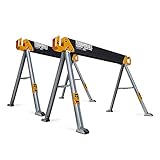
The best value choice for most small workshops
For general DIY work, look for a pair of folding sawhorses rated for at least 1,000 pounds per pair, with a working height between 24 and 32 inches. A set with integrated top slots or shallow grooves is more useful than a completely flat top because it helps hold 2x4s and keeps a sacrificial worktop from sliding.
A folding sawhorse set rated around 1,000 pounds is usually the value sweet spot. The rating is generally more than enough for a sheet of plywood, a small cabinet, or a stack of lumber. Do not treat the printed number as a guarantee that the pair will remain steady under a concentrated load. A 400-pound load spread across a 4-by-8-foot sheet is easy; a heavy engine block sitting near one corner is a different test.
Plastic folding models are often the best buy for a small home workshop. They are light, resist rust, and usually include carry handles. Steel folding models can feel more rigid, but inexpensive versions may have thin tubing, loose hinges, or paint that chips and allows rust to start. Choose steel if you regularly handle heavy hardwood, masonry, or a benchtop planer. Choose plastic if portability and storage matter more than maximum stiffness.
What to compare before buying
| Feature | Budget plastic | Heavier steel or reinforced model | What it means in use |
|---|---|---|---|
| Typical pair capacity | 800–1,200 lb | 1,000–2,400 lb | Both handle normal DIY loads; higher ratings help with concentrated weight. |
| Weight per pair | 10–20 lb | 18–35 lb | Lighter is easier to carry, but often moves more when sawing. |
| Working height | 24–32 in. | 28–36 in. | Lower is better for cutting; taller may be more comfortable for assembly. |
| Storage depth | 3–6 in. folded | 4–8 in. folded | Check this dimension if the pair will live beside a washer or shelving. |
| Best use | Sheet goods, trim, painting, light framing | Heavy lumber, repeated cutting, rough jobsite work | Buy for your actual loads, not the biggest number on the package. |
Pay close attention to the feet. Wide, non-skid feet are more important than a dramatic load rating when you work on smooth garage concrete. Narrow feet can skate during a hand-saw cut, and hollow plastic feet can flex if the floor is uneven. Locking braces should snap fully into position and remain locked when you lift one end of the sawhorse.
When the cheaper option is fine
A basic folding pair costing roughly $30 to $50 is adequate for occasional home use. It is a sensible choice if you need to cut trim, support a hollow-core door while painting, or create a temporary table with a sheet of 3/4-inch plywood. The cheaper option becomes less attractive when the hinges feel loose out of the box, the legs twist under hand pressure, or the top is too narrow to support your work without an additional board.
Do not pay extra simply for a 2,000-pound rating if your heaviest job is breaking down cabinet plywood. Spend the difference on a straight, flat worktop and four clamps. A pair of sawhorses alone is not a safe table for a router, circular saw, or planer. The cutting forces can push the stock sideways, especially when the horses are set on an uneven floor.
For a sturdier setup, consider a heavy-duty steel folding sawhorse set. The extra cost is justified when you routinely handle solid hardwood, long framing lumber, or assemblies that must remain square while you work. The trade-off is real: heavier horses are more stable but less likely to be put away after every job.
How to get a stable setup
Place the horses about 5 to 7 feet apart for a standard 8-foot sheet, keeping each one at least 6 inches in from the ends. Add a 2×4 or 2×6 across the top if the sawhorse has narrow contact points. For sheet goods, use two parallel supports under the plywood and add a third in the middle when making plunge cuts or using a track saw. This reduces sag and prevents the offcut from dropping into the blade.
Use a sacrificial work surface when cutting. A cheap sheet of rigid foam insulation is particularly useful: it supports plywood across its full area and lets you make shallow cuts without striking the horses. If you use a solid top, keep the blade depth set so it extends only about 1/8 inch below the material. That prevents unnecessary damage and reduces the chance of cutting into a hidden support.
Before each job, open both braces completely, check that all locking tabs are engaged, and press down on opposite corners. If a horse rocks, reposition it or shim the feet with a proper wedge. Never rely on a loose scrap under one leg while operating a circular saw. Replace cracked plastic, bent legs, or hinges that no longer lock positively.
When to buy for the best price
Folding sawhorses are commonly discounted during spring tool promotions, Father’s Day sales, and the weeks before Labor Day. Prices also tend to fall during November holiday events, although popular sets can sell out. Compare the delivered price of a pair, not the headline price for one horse. Some listings show a low price but include only a single unit.
If you need a set immediately, buy the inexpensive pair that meets the capacity and stability requirements rather than waiting months for a small discount. If your need is seasonal, watch prices in March and November and set a target: around $35 to $50 for a sound basic pair, $50 to $90 for a more capable reinforced set, and more only when the design offers a genuine advantage such as adjustable height, replaceable feet, or integrated material supports.
For most small workshops, a folding plastic pair with clamps or material supports offers the strongest value. If you already own a sturdy workbench and only need occasional support, the cheapest reliable pair is enough. If the sawhorses will become your primary work surface, spend more on rigidity, wider feet, and locking hardware rather than paying for an inflated load rating.