Best Budget Rolling Workbench for a Space-Constrained Workshop
What's inside
As an Amazon Associate I earn from qualifying purchases. This post may contain affiliate links at no extra cost to you.
A rolling workbench can make a cramped workshop more useful, but a big top and four casters do not automatically make a good buy. For a small shop, the best value is usually a compact bench with a sturdy frame, locking wheels and a top that suits the work you actually do. Skip features that eat floor space without solving a real problem.
As an Amazon Associate we earn from qualifying purchases at no extra cost to you.


Start with the footprint
Measure the bench’s full footprint, including handles and anything that sticks out, then mark it on the floor with tape. Leave room to walk around it and open drawers. A bench that is 24 inches deep may look compact online, but drawers can need another 16 to 20 inches of clearance to open fully.
For a tight garage or basement, a top around 24 by 36 inches is a useful starting point for hand tools, small assemblies and occasional repairs. A 24-by-48-inch top gives more working room, but may be harder to park beside a car or move through a narrow doorway. Check the packaged dimensions too: some benches arrive assembled or in large panels that will not fit through a stairwell.
Think about where the bench will live when it is not in use. If it must roll out for every project, measure the route, including doorways, floor transitions and stored items. Small hard casters can snag on cracks and extension cords; larger wheels roll more easily but raise the bench and can add cost.
What matters for value
Stability comes before storage. A thin steel frame with a deep drawer stack may wobble when you saw or clamp stock. Look for cross-bracing, solid joints and a top that does not visibly flex under pressure. Published capacity figures can help, but they are not a substitute for checking how the load is distributed. A high total capacity does not mean one small area of the top can safely take that weight.
Casters need to lock securely. Four swivel casters make a bench easy to steer, but the bench may drift when you push a plane or tighten a clamp. At least two locking wheels are a baseline; four total-lock casters are better if you regularly do forceful work. A lock should stop both the wheel and its swivel, not just the wheel turning. Even then, a rolling bench is less planted than a fixed cabinet or worktable.
Choose the top for your work. Steel is easy to wipe clean and useful for parts, but it can be slick and noisy. A wood or laminated top is friendlier for assembly and clamping, though it can dent or stain. A thin top over a lightweight frame may need a sacrificial plywood layer. If you plan to install a vise, confirm that the top and frame can handle the load before buying.
Storage is useful only if it does not crowd the shop. Drawers help contain small tools, while an open lower shelf is cheaper and easier to fit around bulky items. Check drawer depth and travel: shallow drawers often waste space for larger tools, and a loaded drawer can make a narrow bench feel top-heavy when pulled out.
Compare budget options
These are practical categories, not promises about a particular model’s dimensions or capacity. Prices vary by retailer, size and season, so compare the total cost delivered rather than relying on a low headline price.
| Type | Typical trade-off | Best fit |
|---|---|---|
| Compact steel rolling bench | Small footprint and simple cleanup; often limited top area and drawer capacity | Apartment garages, maintenance tasks and light assembly |
| Rolling tool cabinet with a top | More enclosed storage; can cost more and be less comfortable for clamping | Keeping hand tools organized in a shared workshop |
| Foldable or mobile worktable | Easy to store; generally less suited to heavy vise work or repeated impacts | Occasional projects where floor space matters most |
| DIY plywood bench on locking casters | Can be sized to the room; takes time and needs careful bracing | Buyers with basic tools who want a custom footprint |
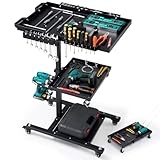
A compact rolling workbench is usually the straightforward choice if you want a ready-made unit. A rolling tool chest with a work surface makes more sense when storage is the priority, but verify that its top is intended for workshop use rather than just as a cabinet lid.
When cheaper is fine
A basic folding workbench can be the right low-cost answer for sanding, assembling small projects or holding a tool during repairs. It is not automatically a poor purchase. The trade-off is that many folding designs have less mass and can shift under side loads. Avoid using one as a stand for a vise, heavy hammering or a job where a slipping workpiece could cause injury.
You can also add locking casters to a basic bench, but do not bolt them onto weak legs and assume the result is safe. The wheels raise the center of gravity and transfer loads through their mounting plates. Use casters rated for the weight of the bench, tools and workpiece, with a margin; four 100-pound-rated casters do not guarantee a safe 400-pound working load. Fasten them into solid framing, not just thin plywood.
Check before buying
Read reviews for specific failure patterns: bent caster plates, drawers that bind when loaded, missing hardware, or tops that arrive damaged. A few complaints about a cosmetic dent are different from repeated reports that the unit will not stay put. Confirm whether assembly requires two people and whether the package includes casters, keys, a top mat or mounting hardware.
For seasonal pricing, compare the same size and configuration across retailers during major holiday promotions and end-of-year clearance. A larger discount is not a bargain if shipping erases it or the model has the wrong footprint. Set a delivered-price ceiling before shopping, and prioritize a rigid frame, useful locking casters and a suitable top over extra drawers.
Make the choice
For most space-constrained workshops, choose the smallest bench that leaves enough room for your common jobs, then spend the saved money on better casters or a replaceable top. If you do mostly light work, a cheaper folding table or simple mobile bench may be entirely adequate. If you clamp, plane or hammer regularly, stability matters more than built-in storage—and a fixed bench may be the better value if you do not truly need to move it.