Compact vs Full-Size Impact Drivers: Comparing Cost and Practical Use
What's inside
As an Amazon Associate I earn from qualifying purchases. This post may contain affiliate links at no extra cost to you.
What “compact” and “full-size” mean
Impact drivers are usually sold in the same 12-volt or 18-volt battery families, but their bodies, motors, and output differ. A compact driver is shorter and lighter; a full-size driver is generally longer, has more room for a larger motor or cooling, and may deliver more torque. Manufacturers don’t use “compact” consistently, so compare the tool’s length, bare-tool weight, and published performance rather than relying on the label.
For many buyers, the choice is less about maximum torque than about how often the tool fits the work. A few ounces and an inch of length matter when driving screws overhead or into a cabinet. They matter much less when fastening deck framing in open space.
As an Amazon Associate we earn from qualifying purchases at no extra cost to you.



Upfront cost and value
Compare complete kits, not just bare tools. A bare driver may look inexpensive, but batteries and a charger can make a new battery platform a poor-value purchase. If you already own compatible batteries, a bare tool is often the cheapest sensible option. If you don’t, kit prices fluctuate during holiday sales, spring promotions, and brand events; compare the included battery capacity and charger as well as the price.
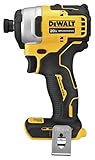
Compact models are not automatically cheaper. Some are premium tools designed to save space and weight, while entry-level full-size drivers can cost less in a kit. On the other hand, a basic compact driver may be a better buy than a powerful flagship if your regular jobs involve cabinet hardware, small repairs, or ordinary wood screws. Look at current compact impact driver options and compare them with kits on the battery platform you already use.
Practical comparison
| Factor | Compact driver | Full-size driver |
|---|---|---|
| Reach | Shorter head is easier between joists, inside cabinets, and beside obstacles | More likely to hit nearby framing or a cabinet wall |
| Weight | Usually less tiring overhead; actual kit weight depends on battery | Often heavier, especially with a high-capacity battery |
| Fastening pace | Good for common screws and repetitive light-to-medium work | More reserve for long, thick fasteners and sustained heavy work |
| Heat and workload | Can struggle or slow down under repeated demanding fastening | Often better suited to long runs of large fasteners, though duty limits still apply |
| Typical value | Worth paying for when access and reduced fatigue save time | Worth paying for when heavy fastening is frequent, not occasional |
Specifications need context. Torque figures are not perfectly comparable across brands or test methods, and high numbers don’t guarantee faster work. A driver with several speed settings can be more useful than a higher-rated tool that is easy to overdrive. Check published length and weight, and treat advertised torque as a rough comparison within a brand’s range, not a promise that one tool will outperform another on every fastener.
When a compact driver is enough
For assembling furniture, installing cabinet hardware, fastening electrical boxes, and driving ordinary screws into framing, a compact model is often the practical choice. It is easier to control in confined spaces and less tiring for repeated overhead tasks. With the right bit and a fully charged battery, it can also handle occasional longer screws, provided you work at a sensible pace and don’t expect it to behave like a production tool.
The main failure mode is asking too much of a small driver: driving many large structural screws back-to-back can slow the tool, heat the motor or battery, and drain a small battery quickly. If it begins to bog down, stop rather than holding the trigger until it overheats. Drill a pilot hole where appropriate, use a fresh battery, and move up to a more capable tool for repeated heavy fastening. For mixed household repairs, browse compact 18-volt impact driver kits if you need a battery and charger, or compare bare tools if you already own that platform.
When full-size pays off
A full-size driver makes more sense for regular deck work, fencing, construction, or driving long screws into dense lumber. The extra power reserve can reduce stalls and keep work moving, particularly when paired with a suitable battery. It is also the safer value choice if the tool will be shared across a jobsite, where users may not adjust their pace or choose fasteners carefully.
More power has a trade-off: it can snap small screws, strip heads, or split wood if you pull the trigger carelessly. Start on a lower speed setting when available, keep the bit seated, and finish delicate fastening by hand if needed. A full-size tool can be less convenient in a tight cabinet, and buying extra power for a handful of large screws each year may not justify the cost. For frequent heavy use, compare 18-volt impact drivers sold as bare tools against compatible kits.
Battery choice and buying timing
Battery size changes balance and runtime. A compact battery often makes a small driver nimble; a larger battery may provide more work between charges but can make the tool heavier and less comfortable overhead. Don’t buy the biggest battery just because it has the highest capacity. For occasional home use, one modest battery may be adequate, while a second battery is valuable if you work continuously and cannot wait for a charge.
Seasonal discounts are useful only when the kit fits your needs. Check whether a promotion includes a battery you will actually use, whether the charger works with your other tools, and whether the deal is for a bare tool or a complete kit. Avoid paying a premium for an advanced model to solve a problem that a short bit, better access, or a pilot hole would fix.
A straightforward buying rule
Choose compact if most of your work is light or medium fastening, you often work in tight spaces, or you value low weight more than maximum speed on large screws. Choose full-size if heavy fasteners are routine and the driver will see long, demanding work sessions. If neither description fits, the cheaper compatible option is usually fine: an occasional tough fastener is not a strong reason to replace an otherwise capable tool. Spend the difference on good impact-rated bits, which are a frequent weak point when they are worn or mismatched to the screw head.