How to Prioritize Tool Purchases When You Are Starting From Scratch
What's inside
As an Amazon Associate I earn from qualifying purchases. This post may contain affiliate links at no extra cost to you.
Starting a tool collection from zero is less about finding the “best” brand and more about avoiding purchases that sit unused. A $25 tool that solves three common jobs is usually a better first buy than a $200 tool that does one job slightly faster. Build around the work you actually expect to do, then add tools when a repeated task justifies them.
Start With the Work, Not the Brand
Write down the next five jobs you expect to tackle. Typical examples include assembling furniture, hanging shelves, repairing drywall, maintaining a car, or building a deck. Separate those jobs into three groups:
- Immediate: work you will do within the next month.
- Likely: tasks you expect to handle several times this year.
- Occasional: jobs that may happen once or can be handled by renting.
Buy for the first two groups. Rent or borrow specialty equipment for the third until you know you need it. A tile saw used once does not belong in a starter kit just because it is useful in theory. The same applies to drain snakes, large sanders, demolition hammers, and heavy-duty ladders.
Buy the Core Hand Tools First
A basic hand-tool set covers a surprising amount of household work and does not become obsolete when battery platforms change. Start with a 16- to 25-foot tape measure, utility knife, combination pliers, adjustable wrench, claw hammer, level, screwdrivers, hex keys, and a bit driver with common Phillips, slotted, Torx, and hex bits.
Pay particular attention to the tape measure and bits. A tape with a blade that stands out 8 feet or more is easier to use alone, while cheap bits can round out after only a few stubborn screws. You do not need premium pliers for hanging pictures, but loose jaws and a flimsy tape hook create frustration on almost every job.
A basic hand tool set can be a good value if it contains useful individual tools rather than filler pieces. Check the contents before buying. A 100-piece kit may count duplicate bits, tiny sockets, and tools you will never use while omitting a decent level or utility knife.
Choose One Battery Platform Carefully
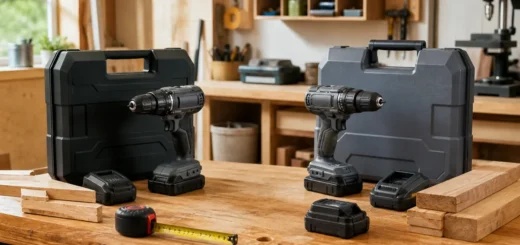
If you will do more than occasional drilling, choose a cordless platform and stay with it. Batteries and chargers are often the most expensive part of a cordless collection. Mixing brands can leave you buying three chargers and several battery types for jobs that could have used one system.
For light household work, a compact 12-volt drill or driver is easier to handle and usually cheaper. For deck screws, long bits, hole saws, and masonry drilling, an 18- or 20-volt system gives you more reserve. A drill/driver is the first cordless tool for most people; an impact driver is helpful when driving many long screws but is less suitable for delicate hardware because it can strip fasteners quickly.
| Purchase | Best use | Typical sensible budget | Where cheap is acceptable |
|---|---|---|---|
| 12-volt drill kit | Furniture, cabinets, small repairs | $70–$150 | Fine for light use if the chuck holds bits securely |
| 18/20-volt drill kit | General repairs, shelving, outdoor projects | $100–$220 | Fine for occasional work; expect less runtime and rougher balance |
| Corded drill | Infrequent drilling and fixed workshop use | $40–$90 | Often the best value if you do not need portability |
| Impact driver | Repeated long screws and construction work | $100–$220 with battery | Acceptable for framing, but use low speed near finished surfaces |
Do not buy a bare tool before checking battery prices. A $60 tool that requires a $100 battery is not cheaper than a $120 kit with a battery and charger. Also check whether the manufacturer offers smaller batteries; a compact pack reduces wrist fatigue for overhead work.
Budget for Safety and Consumables
Safety gear is part of the tool budget, not an optional upgrade. Buy safety glasses, hearing protection, work gloves, a dust mask or suitable respirator, and a basic first-aid kit. A $10 pair of glasses can prevent an expensive eye injury, and hearing damage from saws and grinders is permanent.
Consumables determine whether a tool performs well. Budget for drill bits, driver bits, blades, sandpaper, anchors, screws, and replacement utility blades. A mediocre drill with sharp bits often outperforms an expensive drill with worn bits. For masonry, use masonry bits; forcing a wood bit into concrete can overheat it within seconds.
Buy a drill and driver bit set with common sizes rather than the largest assortment available. A practical starter range is roughly 1/16 to 1/2 inch for general drilling, though larger holes usually call for spade bits or hole saws. Replace bits when they wander, smoke, or require heavy pressure.
Compare Brands by Total Cost
Brand value is more than the sticker price. Compare the kit price, battery cost, warranty, local availability, and the price of replacement parts. A bargain brand may be excellent for a homeowner who uses a drill ten times a year. A professional-oriented platform can make more sense when you need several tools, because the batteries, ergonomics, and service support improve with frequent use.
Look for a brushless motor when the price difference is modest and you expect heavy use. Brushless tools generally run cooler and use battery power more efficiently, but a brushed drill is perfectly adequate for assembling furniture or hanging a few shelves. Do not pay extra for brushless performance that your workload will never use.
Use Seasonal Sales Without Chasing Every Deal
Major tool discounts commonly appear around Black Friday, Father’s Day, spring home-improvement events, and holiday clearance periods. Battery kits and bundles often provide the best value, while individual bare tools are frequently discounted after a newer generation appears.
Set a target price before shopping. For example, decide that a basic cordless drill kit is worth buying at $100 or less, then wait rather than buying at $160 simply because the package is labeled “sale.” Check the included battery size and charger; a small battery may make a cheap kit frustrating outdoors.
Finally, keep a purchase list with three columns: tool, job it solves, and rental or borrowing alternative. Move a tool to the top only after you have needed it twice or spent more than its rental cost. That rule builds a useful collection while protecting your budget from attractive but low-value purchases.