Best Value Cordless Pruner for Small Orchard and Garden Tasks
What's inside
As an Amazon Associate I earn from qualifying purchases. This post may contain affiliate links at no extra cost to you.
A cordless pruner is useful when hand loppers become tiring but a chainsaw would be excessive. For a small orchard, garden, or a few fruit trees, the best value is usually a compact electric pruning shear with a replaceable battery, a 20–25 mm cutting capacity, and enough runtime for a normal afternoon of maintenance. Paying more can buy better balance and longer service life, but the cheapest tool is often adequate for seasonal trimming.
As an Amazon Associate we earn from qualifying purchases at no extra cost to you.


What matters in a cordless pruner
Start with cutting capacity, not voltage. A pruner rated for 20 mm (about 3/4 inch) handles most annual fruit-tree shoots, grape canes, roses, shrubs, and small branches. A 25–30 mm rating gives more margin for neglected growth, though it usually adds weight and cost. Manufacturers measure capacity in ideal softwood, so do not assume a “30 mm” tool will cleanly cut every dry, crooked hardwood branch.
Battery type is the next major value decision. Some inexpensive pruners use a built-in lithium-ion battery charged through USB or a wall adapter. They are convenient and cheap, but the entire tool may become uneconomical when the battery loses capacity. Models using a slide-in battery pack cost more initially, yet the same battery can often power a drill, trimmer, or saw from that brand’s range.
Look for a narrow head, a progressive trigger, and a safety lock that is easy to operate with gloves. A wide head can be awkward between crowded branches. Progressive control matters when you are cutting close to a trunk or trying to avoid crushing a thin stem. Blade material matters too, but replaceable blades matter more than marketing claims about coatings.
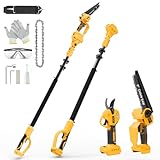
For a small property, browse 20 mm cordless electric pruning shears before jumping to a professional model. This size is the sensible starting point for most garden work.
Best-value cordless pruner categories
| Type | Typical capacity | Best use | Main drawback |
|---|---|---|---|
| Built-in battery pruner | 12–20 mm | Light garden pruning and a few trees | Battery replacement may not be practical |
| Compact tool-system pruner | 20–25 mm | Regular orchard and landscape maintenance | Higher tool and battery cost |
| Professional high-capacity pruner | 25–40 mm | Heavy pruning and daily use | Expensive and often heavier |
| Long-reach cordless pruner | 10–20 mm | High shrubs and light overhead work | Poorer balance and less cutting force |
For occasional use, a built-in battery tool is fine if your workload is modest: perhaps two or three young trees, berry bushes, and routine garden cleanup. Expect roughly 300 to 800 cuts from a small battery depending on branch size, temperature, and how often the blade stalls. That is enough for many homeowners, but not necessarily enough for an orchard renovation.
A battery-platform pruner is the better value when you already own compatible batteries. The tool-only price can be reasonable, and a 2 Ah pack is generally easier to carry than a large pack. If you are starting from zero, include the battery and charger in the comparison. A “cheap” bare tool can cost more than a complete kit after those extras are added.
When cheap is good enough
Choose the cheaper option when branches are mostly under 15 mm, you prune fewer than 20 trees per year, and you can accept slower work. Basic electric shears commonly have adequate power for fresh apple, pear, peach, grape, rose, and ornamental growth. They become frustrating when used on dry wood, forked branches, or material close to their maximum rating.
The common failure modes are predictable. A dull blade forces the motor to work harder and leaves a torn stub. A loose blade creates pinching and incomplete cuts. Cheap trigger switches can become intermittent after dust and moisture enter the housing. Built-in batteries may run normally for one season and then deliver only a fraction of their original runtime. These are reasons to favor a tool with available replacement blades and a published battery or parts policy.
Do not use a pruner to cut material it cannot close around. Repeatedly forcing the jaws against oversized branches overheats the motor, chips the blade, and can damage the gear mechanism. For anything above the tool’s comfortable range, switch to bypass loppers or a pruning saw. A cordless pruner is a finishing and maintenance tool, not a substitute for every cutting tool.
Comparing brand value
Brand value is mostly about the battery ecosystem, parts support, and warranty rather than the logo on the housing. Established tool brands usually make more sense if you already own their batteries. Their pruners may cost more, but replacement packs, chargers, blades, and service are easier to find. Generic kits can win on purchase price, especially for light annual use, but check whether replacement blades are sold before ordering.
For a new battery system, compare the price of a pruner kit, a second battery, and one replacement blade. A second small battery is often more useful than buying the highest-capacity pack. It reduces downtime without making the tool unnecessarily heavy. If you need a platform for several tools, see 20V cordless pruning shears sold as tool-only options, but verify battery compatibility carefully; similar voltage labels do not make battery systems interchangeable.
When to buy and how to save
Prices are often better during late spring promotions, Father’s Day sales, and autumn tool clearances. Late winter can also be a good time to buy before pruning season, although popular kits may sell out. Watch the complete kit price rather than the advertised discount. A $60 tool with a $40 battery is not a $60 purchase.
For most small orchards, the strongest value target is a 20–25 mm pruner with a removable battery, a spare or replaceable blade, and a weight under about 2.5 pounds with the battery installed. If your work is limited to roses and young fruit trees, a small rechargeable cordless pruner can save money without giving up much practical performance.
Use and maintenance
Make clean cuts just outside the branch collar, keeping the blade side toward the piece you want to retain. Stop if the jaws stall, and never hold a branch with your free hand directly in front of the blade. Wear eye protection; brittle twigs can eject when the cut closes.
After each session, brush away chips, wipe sap from the blade, and apply a light tool oil to the pivot. Sharpen or replace the blade when cuts require repeated trigger pulls or leave crushed edges. Store the battery indoors, especially below freezing. These simple habits prevent the most common reason a budget pruner feels worn out long before its motor actually fails.