Best Budget Hex Key Set for Furniture Assembly and Bicycle Maintenance
What's inside
As an Amazon Associate I earn from qualifying purchases. This post may contain affiliate links at no extra cost to you.
For furniture assembly and bicycle maintenance, a hex key set does not need to be expensive—but it does need to fit accurately. A loose-fitting key rounds bolt heads, slips under hand pressure, and can leave you unable to remove a fastener later. The best budget set is usually a metric set with common sizes, a sensible handle design, and enough steel quality for repeated use.
As an Amazon Associate we earn from qualifying purchases at no extra cost to you.


What to Look For in a Budget Hex Key Set
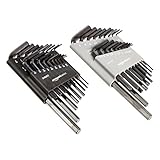
Start with a metric set covering at least 1.5 mm through 10 mm. Furniture hardware commonly uses 4, 5, and 6 mm bolts. Bicycles use 2, 2.5, 3, 4, 5, and 6 mm most often, with 8 mm appearing on pedals, cranks, and some axle hardware. A set that stops at 6 mm may be adequate for an occasional flat-pack bookcase, but it is incomplete for bicycle work.
Look for keys made from heat-treated chrome vanadium steel or a similar tool steel. Black oxide and chrome finishes both work; the finish matters less than the accuracy of the working ends. Ball ends are useful for reaching an angled bolt, but they should not replace standard hex ends. Use the straight end to loosen tight fasteners and apply final torque. Ball ends are more vulnerable to twisting and rounding when heavily loaded.
A folding set is compact and hard to lose, but the plastic or metal holder can get in the way around recessed bicycle bolts. L-shaped keys give better access and usually cost less. T-handle sets are comfortable for repeated adjustments, though they take more drawer space and often omit the smallest sizes. For most households, a standard metric hex key set is the best starting point.
Budget Set Types Compared
| Set type | Typical price | Best use | Main drawback |
|---|---|---|---|
| Basic L-key set | $8–$15 | Flat-pack furniture and occasional bike adjustments | Holder may be flimsy; limited corrosion protection |
| Ball-end L-key set | $12–$25 | General household use and awkward access | Ball ends can break or round under high load |
| Folding hex key set | $10–$25 | Storage in a bike bag or kitchen drawer | Bulky around recessed bolts; less leverage |
| T-handle set | $25–$60 | Frequent bicycle work or workshop use | Higher cost and larger storage footprint |
The cheapest set is fine if you are assembling one desk, chair, or shelving unit and expect only occasional use. Spending closer to $15–$25 is worthwhile if you maintain a bicycle, work on several pieces of furniture, or have previously damaged fasteners with an ill-fitting key. A more expensive set is not automatically better, but consistent sizing and stronger keys become noticeable when a bolt is over-tightened or corroded.
Best Value Choice for Most Buyers
Choose a metric L-key set with sizes from 1.5 mm to 10 mm, including both straight and ball ends if the price difference is modest. A 9-piece or 13-piece set is normally enough. A 13-piece set may add 7, 8, 9, and 10 mm sizes, which are useful on bicycles and larger furniture joints.
For a practical budget target, look for a set priced around $10–$20 during normal sales. Keys should have clearly marked sizes and a holder that releases individual pieces without requiring excessive force. A holder that bends immediately is annoying, but it is not a safety problem; inaccurate key ends are the real concern.
If bicycle maintenance is the priority, consider a metric ball-end hex key set with conventional ends on the opposite side. The ball ends help with bottle-cage bolts, derailleur hardware, and seatpost clamps where a straight approach is difficult. Do not use the ball end to force a seized bolt. Insert the straight end fully, then add leverage carefully.
Using Hex Keys on Furniture
Before tightening, start every bolt by hand for several turns. Flat-pack furniture often uses threaded inserts or barrel nuts that can cross-thread if the bolt enters at an angle. Tighten each fastener gradually, alternating between bolts on the same joint. This keeps panels aligned and reduces stress on particleboard.
Stop when the joint is secure and the panels are flush. Over-tightening can pull an insert out of chipboard, crush a soft wood edge, or strip the internal hex recess. If a 4 mm key begins to twist, check that you are using the correct size rather than applying more force. Some inexpensive furniture hardware has shallow or poorly formed recesses; a quality key cannot completely fix defective hardware.
Using Hex Keys on Bicycles
Clean dirt from the bolt recess before inserting the key. Push the tool fully into the fastener and keep it square while turning. Common bicycle torque ranges are low: a stem faceplate may require roughly 4–6 Nm, while a bottle-cage bolt may need only about 3–5 Nm. A long L-key can easily exceed those figures by hand.
For safety-critical parts such as stems, handlebars, seatposts, and brake controls, a torque wrench is a better investment than upgrading from a $15 hex set to a $30 set. Use the hex key to position the bolt, then use the torque wrench for final tightening according to the component markings. A bicycle torque wrench with hex bits costs more, but it helps prevent both slipping parts and crushed carbon components.
Replace a key if its corners are visibly rounded, twisted, or pitted with rust. Continuing to use it can turn a routine repair into a drilled-out bolt. If a fastener is already damaged, stop using the matching hex key and assess whether locking pliers, a screw extractor, or professional help is appropriate.
When to Buy and When to Spend More
Hex key sets are commonly discounted during spring bicycle sales, Father’s Day promotions, summer tool events, and November holiday sales. The lowest price is not always the best deal: a $9 set that lacks 8 mm and 10 mm keys may cost more after you buy replacements.
Buy the basic L-key set when your work is occasional and the fasteners are clean. Choose ball ends when access is the problem. Upgrade to T-handles only if you make frequent adjustments and value speed and grip more than compact storage. For a household toolkit, accurate metric keys in the $10–$20 range offer the strongest balance of price, coverage, and durability.