Best Affordable Marking Gauge for Beginner Woodworkers
What's inside
As an Amazon Associate I earn from qualifying purchases. This post may contain affiliate links at no extra cost to you.
A marking gauge is one of the simplest tools in a beginner’s kit: a fence rides against the edge of a board while a pin or knife marks a consistent line. That repeatability matters more than having a large collection of expensive measuring tools. A good gauge helps with mortises, tenons, rebates, drawer parts, and any layout where a pencil line is too wide or inconsistent.
For most beginners, the best value is a traditional wooden marking gauge with a single cutter or marking pin. Expect to spend about $15 to $35 for a usable budget tool, $35 to $70 for a better-finished gauge, and more than $70 for premium hardware and hand-fitted parts. The cheapest gauge can work, but poor adjustment and a loose fence quickly make it frustrating.
As an Amazon Associate we earn from qualifying purchases at no extra cost to you.



What to Look For in an Affordable Marking Gauge
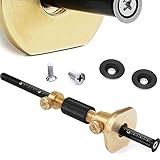
The fence should slide smoothly on the beam and lock firmly with one hand. Test this by unlocking it, moving it, and tightening it repeatedly. If the fence rocks noticeably or shifts when you tighten it, the gauge will not hold a reliable setting. A small amount of stiffness is acceptable; side-to-side play is not.
Look for a beam that is straight and a fence face that is reasonably square to it. A fence that leans can place the cutter at a slightly different distance depending on how you hold the tool. This may only be a fraction of a millimeter, but that is enough to create a poor-fitting joint.
The marking element is either a pointed pin or a knife-style cutter. A pin is inexpensive and works well across the grain, especially for rough layout and softwood. It tends to follow the grain when marking hardwood and can leave a ragged line. A knife produces a cleaner shoulder and is usually better for joinery, but it needs occasional sharpening and costs slightly more.
Choose a fence large enough to register comfortably against the board edge. Around 50 to 75 mm (2 to 3 inches) of fence height is practical for most beginner projects. Very small fences can be awkward, while oversized fences add bulk without improving accuracy on ordinary furniture parts.
The Best Budget Types
| Gauge type | Typical price | Best use | Main drawback |
|---|---|---|---|
| Wooden pin gauge | $15–$30 | General layout, softwood, basic projects | Pin may follow grain in hardwood |
| Wooden knife gauge | $25–$50 | Mortises, tenons, shoulders, hardwood | Cutter needs sharpening |
| Metal-bodied gauge | $25–$60 | Frequent use and compact storage | Some budget versions have rough adjustments |
| Wheel marking gauge | $30–$80 | Clean, controlled lines on finished work | Less forgiving if the wheel is dull or misaligned |
| Dual-cutter gauge | $35–$90 | Marking both sides of a mortise | More expensive and unnecessary for many beginners |
A basic wooden marking gauge is the sensible starting point when price is the priority. It is easy to understand, easy to repair, and usually provides enough accuracy for shelves, boxes, workbenches, and early joinery practice. The cheaper option is fine if the fence locks without movement and the marking pin is straight.
Spend more on a knife gauge if you plan to cut mortise-and-tenon joints or work mostly with oak, maple, or other dense hardwoods. A knife line severs surface fibers rather than dragging a point through them. That makes chiseling to the line cleaner and reduces splintering.
Brand Value and Build Quality
With budget marking gauges, brand value is mainly a quality-control issue. Established woodworking brands generally provide straighter beams, better-fitted fences, and more consistent cutters. You are not paying for a motor or complicated mechanism; you are paying for parts that fit correctly out of the box.
Unbranded gauges can be excellent value, but inspect them before using them. Common failure modes include a fence that twists when tightened, a beam that is too short for the work, a pin that is permanently loose, and a locking screw that bottoms out before the fence is secure. These problems can be corrected only when the tool has enough material and adjustment range.
A wooden knife marking gauge from a reputable maker is often the best middle ground. It costs more than a generic pin gauge but avoids the price jump of premium metal hardware. If you are buying only one gauge, choose a single-cutter version unless you already know you need to lay out mortises frequently.
How to Use a Marking Gauge Accurately
Set the gauge from the reference edge, not from whichever edge happens to be closest. Plane or sand that reference edge first. Hold the fence firmly against it and make two or three light passes instead of forcing one deep cut. Light passes reduce wandering and leave a cleaner line.
For a joint, mark both mating parts from the same reference face whenever possible. If one part is measured from the top and the other from the bottom, small errors can accumulate. Before cutting, check the setting on a scrap of the same thickness and wood species. A 2-minute test can prevent ruining a board that costs $10 or more.
Do not use a marking gauge as a substitute for a cutting gauge when the line will remain visible on a finished surface. A sharp pencil is often better for rough cuts, while a knife is better for precise joinery. Also avoid pushing the tool against an edge that is rounded, chipped, or covered in dust; the fence will register inconsistently.
When to Buy and What to Pay
Marking gauges are rarely seasonal necessities, but prices often move during major retail events. Check woodworking tools around late November, Father’s Day promotions, and January workshop-clearance sales. Discounts of 10% to 25% are common enough to justify waiting if you do not need the tool immediately. Be cautious of inflated “sale” prices on marketplace listings; compare the current price with several sellers.
For a first gauge, set a practical limit of $30. If the tool passes the fence, beam, and cutter checks, it should handle beginner work. Around $45 to $60 buys a more refined knife or metal gauge with better adjustment. Above that, the improvement is mostly smoother operation, better materials, and long-term durability rather than dramatically better results in inexperienced hands.
A wheel marking gauge is worth considering when you want very controlled lines and do not mind sharpening or replacing a small wheel. For the lowest-cost entry into woodworking, however, start with a well-fitting wooden gauge and put the saved money toward a combination square, sharpening stone, and decent chisel.