Best Budget Motorcycle Tool Kit for Routine Adjustments
What's inside
As an Amazon Associate I earn from qualifying purchases. This post may contain affiliate links at no extra cost to you.
For routine motorcycle work, the best budget tool kit is not the largest case or the cheapest bundle of chrome-plated sockets. It is a compact set that fits common fasteners, includes usable Allen and Torx bits, and survives the torque needed for axle, brake, and suspension hardware. Expect to spend about $50 to $120 for a useful starter setup, depending on whether you already own a torque wrench and screwdrivers.
As an Amazon Associate we earn from qualifying purchases at no extra cost to you.


What Routine Motorcycle Work Requires
Oil changes, chain adjustments, battery access, lever adjustments, mirror removal, and bodywork typically use 8mm, 10mm, 12mm, and 14mm fasteners. Japanese motorcycles often use metric hardware throughout. European motorcycles may add Torx fasteners, while some older bikes use JIS-style cross-head screws that can be damaged by ordinary Phillips drivers.
A sensible kit should include a 3/8-inch drive ratchet, metric sockets from roughly 8mm through 19mm, metric combination wrenches, hex bits from 4mm through 8mm, and several screwdrivers. A 1/4-inch drive is useful for small fasteners, but a 3/8-inch drive handles more of the motorcycle without becoming unnecessarily bulky.
For a first purchase, compare a metric motorcycle tool kit with buying individual tools. Kits usually offer better price-per-piece, but their included pliers, bits, and extensions are often the weakest parts. A smaller kit from a reputable hand-tool brand can be a better value than a 200-piece set filled with duplicate screwdriver bits.
Budget Kit Options Compared
| Kit type | Typical price | Best use | Main compromise |
|---|---|---|---|
| Basic 3/8-inch metric socket set | $35–$70 | Oil changes, battery work, body panels, chain adjusters | Few wrenches, limited Torx and hex coverage |
| Motorcycle-specific 80–120 piece kit | $60–$120 | One-box garage setup and roadside repairs | Uneven quality; specialty pieces may be filler |
| Separate hand tools plus torque wrench | $100–$200 | Regular maintenance and safety-critical fasteners | Higher initial cost and no storage case included |
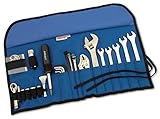
| Compact emergency roll or pouch | $25–$60 | Carrying under the seat or in luggage | Too limited for full servicing |
The basic socket set is fine if you are only changing oil and adjusting a chain. The motorcycle-specific kit becomes worthwhile when it adds long Allen bits, Torx bits, a spark-plug socket, tire tools, or a small adjustable wrench. Check the contents before buying; “motorcycle” in the title does not guarantee that the kit fits your particular bike.
Tools Worth Paying More For
Spend extra on the ratchet, torque wrench, and hex or Torx bits. A ratchet with a fine tooth count—around 72 teeth or more—works better around engine covers and frame tubes because it needs less swing room. A short extension and a wobble extension are more useful than a large collection of shallow sockets.
A budget torque wrench in the $30–$60 range is adequate for routine work if it has a clear scale, a locking handle, and a stated range that covers your motorcycle’s specifications. For most small fasteners, a 1/4-inch torque wrench covering approximately 2–24 Nm is useful. A 3/8-inch wrench covering roughly 20–100 Nm handles many drain plugs, axle nuts, and brake hardware, though you may need a larger wrench for some rear axles.
Do not use a torque wrench as a breaker bar. Loosen stubborn fasteners with a solid ratchet or breaker bar, then tighten with the torque wrench. Store a click wrench at its lowest marked setting, not below it. Cheap torque wrenches can be serviceable, but treat their readings as less trustworthy at the extreme ends of the range.
For cross-head screws, consider a JIS screwdriver set. A Phillips driver may appear to fit but can cam out when removing a tight carburetor bowl, switch housing, or Japanese motorcycle engine cover screw. Once the head is rounded, removal can require locking pliers, an impact driver, or drilling.
Where Cheap Kits Fail
The common failure is not a socket shattering; it is a poor fit that rounds a fastener. Low-cost sockets may have sloppy internal dimensions, and soft hex bits can twist under load. Avoid using a 12-point socket on a tight six-sided bolt when a six-point socket is available. Six-point sockets grip more of the fastener and are the better choice for axle nuts and brake hardware.
Plastic cases are another weak point. Hinges break, sockets fall out, and labels disappear after a few months in a damp garage. A basic tool roll or small organizer can solve this without replacing the tools. Keep tools dry and wipe them after working near chain lubricant, road salt, or brake cleaner.
Very cheap combination wrenches are usually acceptable for light adjustments, such as chain tensioner locknuts, but they may flex on a stubborn axle pinch bolt. Buy a better wrench or use a socket when access allows. Never extend a small wrench with a pipe to gain leverage; that can damage the tool and overload the fastener.
Best Add-On Purchases
After the core kit, buy tools for your specific motorcycle rather than filling gaps at random. A small 1/4-inch torque wrench is often more valuable than another socket size. Add a spark-plug socket only after checking whether your bike uses 16mm, 18mm, or another size.
For frequent chain maintenance, add a 3/8-inch drive torque wrench, a 6mm or 8mm hex-bit socket if required by your axle hardware, and a dependable ruler or chain slack gauge. Chain slack is commonly specified around 20–40mm, but use the motorcycle’s manual and measure at the tightest point. Too-tight adjustment can damage countershaft bearings; too-loose adjustment can produce snatch, noise, or chain derailment.
A compact motorcycle roadside tool roll is useful only after you have tested every tool on your bike. Carry the sizes needed for the axle, levers, mirrors, battery terminals, and bodywork. A kit that cannot remove your own axle or tighten your own chain is just extra weight.
Seasonal Buying Advice
Tool kits often get discounted during spring motorcycle promotions, Father’s Day sales, and November holiday events. Compare the final price rather than the claimed percentage discount; a “100-piece” kit may contain 30 interchangeable bits and several sizes you will never use. Spring is also a good time to buy a torque wrench before riding season, while compact roadside kits are often cheaper during winter clearance.
For most owners, the best value is a 3/8-inch metric socket set, a few quality combination wrenches, JIS drivers, hex and Torx bits matched to the bike, and a properly sized torque wrench. Buy the cheaper kit when its fit is good and your work is light. Pay more when a rounded fastener, inaccurate torque setting, or broken ratchet could leave the motorcycle disabled—or compromise a brake, axle, or suspension repair.