Best Professional Circular Saws for Jobsite Performance
What's inside
- Quick comparison: professional circular saws
- Best overall for cordless jobsite performance: DEWALT DCS578
- Best for maximum cordless capacity: Makita GSR02
- Best lightweight option: Milwaukee M18 FUEL 2830-20
- Best for unlimited runtime: SKILSAW SPT77WML-01
- What matters more than the motor label
- Decision matrix for professional buyers
- Durability and ownership realities
- Bottom line
- Related Guides
- Quick comparison: professional circular saws
- Best overall for cordless jobsite performance: DEWALT DCS578
- Best for maximum cordless capacity: Makita GSR02
- Best lightweight option: Milwaukee M18 FUEL 2830-20
- Best for unlimited runtime: SKILSAW SPT77WML-01
- What matters more than the motor label
- Decision matrix for professional buyers
- Durability and ownership realities
- Bottom line
- Related Guides
As an Amazon Associate I earn from qualifying purchases. This post may contain affiliate links at no extra cost to you.
The best professional circular saws for 2026 are the DEWALT DCS578 for general cordless production work, Makita GSR02 for maximum cordless cutting capacity, Milwaukee M18 FUEL 2830-20 for a compact 6-1/2-inch option, and SKILSAW SPT77WML-01 when uninterrupted corded power matters most. The right choice depends less on headline speed than on cutting depth, tracking, balance, battery or cord logistics, and how well the saw survives repeated exposure to dust and jobsite abuse.
As an Amazon Associate we earn from qualifying purchases at no extra cost to you.
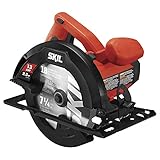
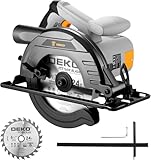


Quick comparison: professional circular saws
| Model | Blade | Maximum cut at 90° | Bevel range | Weight | Power source | Best suited to |
|---|---|---|---|---|---|---|
| DEWALT DCS578B | 7-1/4 in | 2-9/16 in | Up to 50° | About 8.2 lb bare | 60V MAX battery | Heavy framing and general production cutting |
| Makita GSR02Z | 7-1/4 in | 2-9/16 in | Up to 48° | About 11.3 lb with battery | 40V XGT battery | Deep cuts, track-compatible work, high output |
| Milwaukee 2830-20 | 6-1/2 in | 2-1/8 in | Up to 50° | About 7.4 lb with battery | 18V M18 battery | Lightweight overhead and finish-oriented work |
| SKILSAW SPT77WML-01 | 7-1/4 in | 2-3/8 in | Up to 53° | About 11.6 lb | 15-amp corded | Continuous cutting and maximum runtime |
| Bosch GKS18V-25GCB14 | 6-1/2 in | 2-1/8 in | Up to 50° | About 8.4 lb with battery | 18V battery | Balanced cordless framing and jobsite control |
Weights vary with battery, blade, rafter hook, and regional configuration. Treat the figures as comparison points rather than exact carry weights.
Best overall for cordless jobsite performance: DEWALT DCS578
The DEWALT DCS578 is a strong all-purpose choice for framing crews already invested in the 60V MAX platform. Its 7-1/4-inch blade cuts up to 2-9/16 inches at 90°, enough for dimensional lumber, sheet goods, and many doubled-member cuts. The brushless motor delivers the reserve needed to maintain blade speed in dense lumber, while the electric brake and rafter hook suit fast-paced work.
Its main advantage over compact saws is not simply depth; it is reduced need to reposition the workpiece. A full-size blade handles common 2x material in one pass and gives more flexibility for bevel cuts. The trade-off is battery cost and a heavier system than an 18V compact saw. For a crew cutting all day, two or more high-capacity batteries and a rapid charger are part of the saw’s real ownership cost.
Why choose it
- Full-size cutting capacity without a power cord.
- Good match for repetitive framing, roofing, and remodeling cuts.
- High power reserve for wet, treated, or dense lumber.
Best for maximum cordless capacity: Makita GSR02
Makita’s GSR02 40V XGT circular saw is aimed at professionals who want a cordless tool that approaches corded-saw capability. It cuts up to 2-9/16 inches at 90° and supports bevel work to approximately 48°. Its high-output platform is particularly attractive when the crew already uses XGT batteries for rotary hammers, recip saws, or other demanding tools.
The GSR02 is also notable for guide-rail compatibility in configurations designed for track work. That makes it more useful than a typical framing saw when breaking down sheet goods or making long, straight cabinet and trim cuts. However, the larger battery and robust construction make it less nimble overhead than a 6-1/2-inch saw. It is a capacity-first choice, not the lightest choice.
Best lightweight option: Milwaukee M18 FUEL 2830-20
The Milwaukee M18 FUEL 2830-20 uses a 6-1/2-inch blade and provides up to 2-1/8 inches of cutting depth at 90°. That is sufficient for standard 2x lumber, plywood, subflooring, and most daily punch-list work. Its lower weight is valuable when the saw is repeatedly used above shoulder height, from ladders, or while making dozens of quick cuts.
A compact saw does require more planning. A 2x member can usually be cut in one pass, but thicker posts, stacked material, and some bevel cuts may exceed its capacity. If your work routinely involves 4x lumber, laminated beams, or deep angled cuts, the 6-1/2-inch format will create extra passes and slower production.
Choose this model when maneuverability and reduced fatigue are more important than maximum depth. It is especially sensible for remodelers who already own M18 batteries and need a dependable everyday saw rather than the biggest available motor.
Best for unlimited runtime: SKILSAW SPT77WML-01
The SKILSAW SPT77WML-01 remains a practical professional choice when a suitable power source is available. Its 15-amp motor avoids battery changes and provides consistent output for long rip-cutting sessions. The 7-1/4-inch blade cuts about 2-3/8 inches at 90° and bevels to approximately 53°, giving it useful flexibility for framing and general construction.
The cord is the limitation. It can slow movement around a building, create a trip hazard, and restrict work on unfinished sites without dependable power. A corded saw also demands careful inspection of the cord, plug, and extension-cord rating. For a shop, factory-style production area, or stationary cutting station, however, its predictable power can be more economical than maintaining several large battery packs.
What matters more than the motor label
Cutting depth and blade size
A 7-1/4-inch saw generally offers around 2-3/8 to 2-9/16 inches of depth at 90°. That covers common 2x stock with clearance. A 6-1/2-inch saw usually offers around 2-1/8 inches, which still handles ordinary framing lumber but leaves less margin for bevels or imperfect setup.
Do not compare depth at 90° alone. At 45°, usable capacity drops substantially, often to roughly 1-5/8 to 1-7/8 inches depending on the design. If bevel cuts are frequent, inspect the manufacturer’s published 45° capacity before buying.
Tracking and control
Tracking depends on the base, blade, sight line, shoe stiffness, and the operator’s ability to keep the saw moving without twisting. A rigid stamped or machined shoe is preferable to a thin base that flexes under pressure. Clear front and side sight lines help maintain a cut on layout marks, while a well-designed bevel mechanism should lock firmly without shifting when the trigger is released.
For repeated sheet-goods cuts, a compatible guide rail can improve accuracy more than a small increase in motor power. For rough framing, a stable shoe and a sharp framing blade may matter more than track compatibility.
Decision matrix for professional buyers
| Your situation | Most sensible format | Why | Watch-out |
|---|---|---|---|
| Daily framing with no reliable outlet | 7-1/4-inch high-output cordless | Full depth and fewer interruptions | Budget for spare batteries and charging capacity |
| Frequent overhead or ladder work | 6-1/2-inch compact cordless | Lower fatigue and easier handling | Less capacity for thick or bevel cuts |
| Long cutting sessions at one location | 15-amp corded saw | Consistent power and no battery downtime | Cord management and access to suitable power |
| Accurate breakdown of plywood | Track-compatible cordless or corded saw | Better straight-line repeatability | Rail and adapter costs may be additional |
| Occasional professional repairs | Existing battery-platform saw | Avoids buying a new charger and batteries | Do not sacrifice required cutting depth to save platform cost |
Durability and ownership realities
The first consumable is usually the blade, not the motor. Framing blades become dull after contact with nails, embedded grit, treated lumber residue, or concrete dust. A dull blade increases feed pressure, creates rougher cuts, and puts extra load on the motor and bearings. Keep separate blades for framing, plywood, and finish work, and replace rather than forcing a damaged blade through stock.
Dust also affects longevity. At the end of a shift, brush or blow debris away from the shoe pivot, bevel lock, blade guard, battery contacts, and ventilation openings. Follow the manufacturer’s cleaning guidance; excessive compressed air can drive fine dust deeper into bearings and switches. Check that the lower guard returns quickly and completely before each shift, and inspect the shoe for bending after a drop.
For battery models, avoid storing packs fully discharged or in extreme heat. Rotate batteries instead of draining one pack repeatedly while others sit unused. For corded models, inspect the extension cord for cuts and use a gauge suitable for the cord length and saw’s current demand. An undersized extension cord can cause voltage drop and unnecessary heating.
Bottom line
Choose the DEWALT DCS578 when you want a versatile full-size cordless saw for routine framing. Choose the Makita GSR02 when deep cuts, high output, and guide-rail work justify a heavier 40V system. Choose the Milwaukee 2830-20 or Bosch GKS18V-25GCB14 when lower weight and platform convenience matter more than maximum capacity. Choose the SKILSAW SPT77WML-01 when the work is concentrated near dependable power and uninterrupted runtime outweighs cordless freedom.