Best Budget Impact Driver for Building a Small Backyard Deck
What's inside
As an Amazon Associate I earn from qualifying purchases. This post may contain affiliate links at no extra cost to you.
For a small backyard deck, the best budget impact driver is usually a 18V or 20V cordless model from a tool platform you can keep using. You do not need the highest torque rating or a premium brushless kit. You do need a driver with a variable-speed trigger, a one-handed 1/4-inch hex chuck, a usable battery, and enough control for structural screws and ledger hardware.
For most homeowners, a kit in the $80 to $150 range is the sensible target. A bare tool can cost less, but only if you already own compatible batteries and a charger. If this is your first cordless tool, the battery platform matters more than a small difference in impact power.
As an Amazon Associate we earn from qualifying purchases at no extra cost to you.



What the job actually requires
A small deck involves two different kinds of fastening. Framing may require long structural screws, often 3 to 6 inches long, while decking boards usually use shorter coated screws. The driver must start screws cleanly, drive them without stripping the head, and stop before overdriving the fastener into soft lumber.
An impact driver is useful because its hammering action reduces the twisting force transferred to your wrist. It is also shorter than many drills, which helps when working between joists or near a railing. However, the impact mechanism does not make it automatically more precise. A driver with an aggressive trigger and high maximum torque can bury a deck screw below the surface or split a board if you hold the trigger wide open.
For this project, look for variable speed, several electronic speed modes if available, and at least one 2.0Ah battery. A compact 1.5Ah battery keeps the tool light but may run down during a full day of framing. A 4.0Ah battery lasts longer, but adds noticeable weight when you are fastening overhead or from a ladder.
Budget impact drivers compared
| Type | Typical kit price | Best use | Main compromise |
|---|---|---|---|
| Basic brushed cordless kit | $60–$100 | One small deck and occasional repairs | Shorter runtime, more heat, rougher control |
| Budget brushless kit | $90–$160 | Several projects or repeated deck work | Higher upfront cost |
| Compact 12V kit | $80–$150 | Deck boards, trim, and light fastening | Less reserve for long structural screws |
| Bare tool from an existing platform | $50–$130 | Owners who already have batteries | Battery and charger may double the real cost |
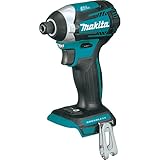
A budget 20V cordless impact driver kit is the safest general recommendation for a first-time deck builder. These tools commonly provide enough output for 3-inch and 4-inch structural screws, provided you predrill where appropriate and use a bit designed for impact tools.
The cheaper brushed option is fine when the deck is small, the work is a one-time project, and you already expect to take breaks. Brushed motors are less efficient and can become hot after sustained fastening, but that does not make them unusable. A homeowner driving a few hundred screws over a weekend may never recover the extra cost of brushless construction.
Brushless versus brushed motors
Brushless drivers usually run longer per charge, stay cooler, and have better electronic control. Those advantages matter when you are building stairs, attaching joists, and driving many long screws in succession. They also tend to have better resale value and remain useful as your tool collection grows.
Brushed drivers can still deliver adequate torque. Their main failure modes are battery drain, heat buildup, and a less refined trigger. If the motor housing becomes too hot to comfortably touch, stop and let it cool. Continuing can shorten motor life or trigger thermal protection at an inconvenient point.
Do not choose based only on a claimed torque number. Manufacturers do not always test torque under identical conditions, and maximum breakaway torque is not the same as controlled fastening power. A driver with a lower published number may be easier to use on decking because it has a smoother trigger and a lower first speed.
Battery platform is part of the price
Compare complete kits, not just tool prices. A $65 bare tool is not a bargain if a battery and charger add another $70. On the other hand, a bare tool is excellent value if you already own batteries from the same platform. Sticking with one battery system also lets you buy a circular saw, trim tool, or work light later without buying another charger.
For a first purchase, a kit with one 2.0Ah battery is adequate for a small deck if you can charge between work sessions. A kit with two batteries costs more but avoids long pauses. A spare battery is especially useful in cold weather, where lithium-ion runtime drops.
A 20V brushless impact driver kit with two batteries is often the better seasonal deal around spring project season and holiday sales. Do not pay extra for an oversized battery unless you also plan to use high-draw tools such as a circular saw.
How to use the driver on a deck
Use impact-rated bits. Ordinary chrome bits can twist, round over, or snap in an impact chuck. Keep a spare bit because one damaged bit can waste more time than its cost.
For structural screws near board ends, predrill according to the screw manufacturer’s instructions. A pilot hole reduces splitting and lowers the load on the driver. Drive the screw until the head is flush or at the specified depth; do not countersink aggressively unless the fastener instructions call for it.
Start in the low-speed setting or use light trigger pressure. Let the bit stay straight and maintain firm pressure so it does not cam out of the head. If the driver repeatedly stalls on a long screw, check the bit, the screw type, and the wood before assuming you need a more powerful tool. Wet, dense lumber and a dull bit can make a capable driver appear weak.
When to buy for the best value
Prices are usually most competitive during spring promotions, Father’s Day sales, Black Friday, and year-end clearance events. Holiday bundles often include a second battery or another tool for little extra money. Check the kit contents carefully: retailers sometimes use similar packaging for a bare tool, a single-battery kit, and a two-battery kit.
For a deck planned within the next few weeks, buy based on the complete kit price and local availability rather than waiting for a small discount. A reliable $100 driver that arrives before your lumber is more valuable than a $75 model that delays the project. If the tool will only build one small deck, a basic brushed kit is a defensible purchase. If you expect regular repairs or want to expand into cordless saws, spend more for a brushless kit on a broad battery platform.