Best Budget Tools for a Small Deck-Building Project
What's inside
As an Amazon Associate I earn from qualifying purchases. This post may contain affiliate links at no extra cost to you.
Start with the deck, not the tool aisle
For a small ground-level deck—roughly 8 by 10 feet, with a simple rectangular frame—you can often build with a short list of reliable tools rather than buying a full contractor setup. The biggest savings usually come from borrowing or renting the few tools used for only part of the job, not choosing the cheapest version of every tool.
Before buying, check the plans and local requirements. Joist spacing, footing depth, ledger attachment, and railing rules vary. A tool budget cannot compensate for a poorly supported deck. Also check whether the lumber is pressure-treated: its moisture and chemicals can affect fastener choice and tool wear.
As an Amazon Associate we earn from qualifying purchases at no extra cost to you.


Buy, borrow, or rent?
Buy tools you’ll use repeatedly for layout, cutting, and fastening. Borrow a specialty tool if a neighbor has one and it’s in safe condition. Renting is sensible for high-cost tools that save only a few hours, especially if you can finish that stage in one day.
| Tool | Budget approach | When it earns its keep | Main compromise |
|---|---|---|---|
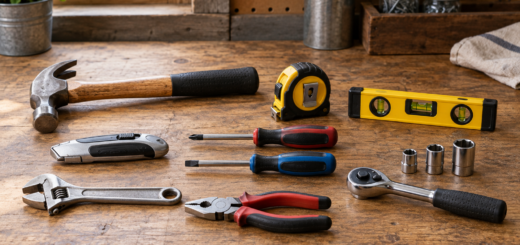
| 25-foot tape measure | Buy a basic, readable model | Layout, board lengths, diagonals | A weak blade bends or sags when extended |
| 4-foot level | Buy a standard box level | Checking posts, beams, and joists | Cheap models may be inaccurate; verify before relying on one |
| Circular saw | Borrow or buy corded | Repeated straight cuts in decking and framing | Cord management, or less portability than a cordless saw |
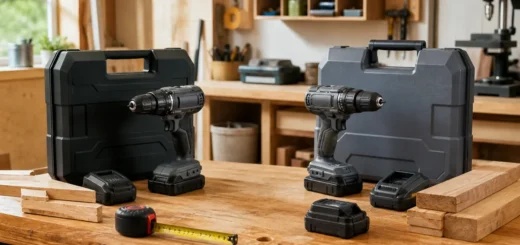
| Impact driver | Buy a value tool or use a drill-driver | Driving many compatible deck screws | A drill-driver is slower and can strain your wrist |
| Framing nailer | Rent or skip | Large framing jobs with approved nails | Often poor value for a small deck; nails may not suit every connection |
Spend modestly on layout tools
A tape with a clear scale and a lock that holds is more useful than a premium tape with features you won’t use. A 25-foot tape covers most small-deck measurements. Check the hook for excessive movement and replace a tape with a cracked case or damaged blade; a few millimeters of error can compound across a layout.
Use a carpenter’s pencil, a chalk line, and a framing square to mark repeat cuts and check corners. For a rectangular layout, measure both diagonals: if the corners are square, the diagonals should match. On an 8-by-10-foot rectangle, each diagonal is about 12 feet 10 inches. Treat that as a check, not a substitute for measuring the sides. A basic framing square and chalk-line set is usually enough.
Do not assume a bargain level is accurate because its bubble looks centered. Check it by placing it on a reasonably flat surface, noting the reading, then turning it end for end. The reading should agree. A level that fails this test can make posts or joists look right while building in a slope.
Choose a saw for the cuts you actually have
A circular saw is the practical budget choice for cutting deck boards and framing lumber. A corded saw can cost less than a comparable cordless setup and avoids buying batteries, but the cord needs attention around the work. For occasional cuts on a small deck, a basic saw with a sharp, suitable blade is generally adequate; accuracy depends as much on supporting the board and guiding the cut as on the saw price.
Check cutting depth before buying. A typical 7¼-inch circular saw can cut common 2-by lumber in one pass, but set the blade depth just below the material to limit exposed teeth. Cheap blades can leave rough edges or burn wet lumber; replace a dull or damaged blade rather than pushing harder. For cleaner crosscuts, clamp a straight board as a guide. A corded 7¼-inch circular saw is a sensible value if you have access to an outdoor-rated extension cord and GFCI protection.
Don’t overspend on fastening
For deck screws, an impact driver makes repetitive work quicker and is less likely than a drill-driver to twist your wrist when a screw binds. But a drill-driver is fine for a small project, especially if you already own one. Use the correct driver bit, keep spare bits nearby, and set the clutch or speed carefully to avoid stripping heads or driving screws too deep into the board.
Fasteners must be approved for the lumber and exposure. Pressure-treated wood generally calls for compatible corrosion-resistant screws, often coated or stainless steel depending on treatment and conditions. Follow the deck plan and fastener maker’s instructions; ordinary interior screws can corrode, weaken, and stain the wood. A basic cordless impact-driver kit is worth considering if you lack a suitable drill, but compare the kit price with borrowing one before buying a battery platform just for this build.
A framing nailer is not an automatic shortcut. For one small deck, setup and rental costs may outweigh the time saved, and structural connections may require specified nails, screws, or connectors. Never substitute a tool’s convenience for the connector schedule in the plan.
Save on extras, not on safety
Wear eye protection while cutting and hearing protection around saws and drivers. A dust mask is useful when cutting treated lumber; keep cuttings out of garden beds and follow local disposal guidance. Use a stable work surface, clamp stock when practical, and disconnect a corded saw before changing its blade. If the deck is elevated, plan fall protection and access before work begins.
Skip specialty tools that solve a problem you don’t have. A laser level, track saw, and premium cordless platform are hard to justify for a straightforward small deck. On the other hand, a dull saw blade, slipping bits, or inaccurate layout tools can waste lumber and fasteners. Price replacements against the cost of one mistaken board length or a stripped box of screws.
Time purchases around the build
Compare prices before the building season, when you have time to wait for a sale, and again at the end of the season, when some stores discount outdoor equipment and older tool stock. Check what a deal includes: a low cordless-tool price may be for a bare tool without a battery or charger. For a one-off project, that can make the apparent bargain more expensive than a corded tool or a rental.
Buy lumber and fasteners only after confirming quantities and specifications, and keep receipts for unopened returns. Avoid buying every tool in a bundle just to get one item cheaply. The best budget setup is the smallest one that can do the work accurately and safely; for a simple deck, that usually means dependable measuring tools, a circular saw, and a drill or impact driver, with specialty equipment borrowed or rented as needed.