Best Value Tools for Building a Workbench on a Tight Budget
What's inside
As an Amazon Associate I earn from qualifying purchases. This post may contain affiliate links at no extra cost to you.
A useful workbench does not need a premium hardwood top, a matched set of cordless tools, or drawers full of specialty hardware. For a basic bench, the best value usually comes from spending on a flat, sturdy top and reliable measuring and fastening tools, then keeping the rest simple. Prices vary by region and season, so treat the figures below as rough U.S. shopping ranges rather than quotes.
As an Amazon Associate we earn from qualifying purchases at no extra cost to you.


Start with the bench design
Before buying tools, choose a practical design. A straightforward bench about 24 inches deep, 48 to 72 inches long, and 34 to 36 inches high is enough for many home projects. Confirm the height against your own work: a lower surface is steadier for hand-planing; a higher one can be easier for assembly and detail work.
Construction lumber is inexpensive, but it can be twisted, wet, or crowned. Sight down each board at the store and reject pieces with pronounced bows or splits near the ends. A simple frame built from straight 2-by-4s with a thick plywood top is often a better budget choice than trying to flatten rough boards without a jointer or planer. A 3/4-inch plywood top works for light duty; two layers glued and screwed together make a stiffer 1 1/2-inch surface for heavier use.
Leave room in the budget for screws, glue, and a way to clamp parts. A low-cost bench can still rack from side to side if its legs and rails are poorly connected. Add diagonal bracing or a plywood back panel if the frame feels wobbly.
Where to spend first
For this build, accuracy and control matter more than high power. A tape measure that retracts cleanly, a square that stays square, and a sharp pencil help prevent errors that are costly to fix after assembly. Check a square by drawing a line along a straightedge, flipping the square, and checking whether the edge aligns with the same line.
Buy a basic 12-inch combination square if you do not already own one. A metal rule and framing square can cover some of the same jobs, but they are less convenient for marking short cuts and checking small parts. Cheap squares sometimes arrive out of true; test before relying on one.
For cutting the frame and plywood, a corded circular saw is often the lowest-cost capable option. It avoids battery-platform costs and has enough power for typical bench materials. Pair it with a straight guide—a factory-cut plywood strip or a clamped straight board—because freehand cuts are easy to steer off line. A basic corded 7 1/4-inch circular saw is fine for occasional DIY use. Expect a budget saw to be louder and less refined than a premium model, and check that its base remains square to the blade.
Budget tool comparison
The right choice depends on what you already own. These broad price ranges are common for entry-level tools and basic accessories; sales can shift them substantially.
| Tool or setup | Typical budget | Best use | Trade-off |
|---|---|---|---|
| Corded circular saw | $40–$80 | Cutting lumber and plywood | Needs a cord and a guide for straight cuts |
| Basic cordless drill kit | $70–$150 | Drilling pilot holes and driving screws | Battery cost matters if you have no matching tools |
| Hand saw | $15–$35 | A few short cuts or trimming | Slower; accuracy depends on technique |
| Bar clamps, pair | $20–$50 | Holding glue-ups and frame parts | Inexpensive clamps may flex under heavy pressure |
| Basic 3/4-inch plywood top | $35–$80 | Light-duty bench surface | Can sag over a wide, unsupported span |
Drill, clamps, and fasteners
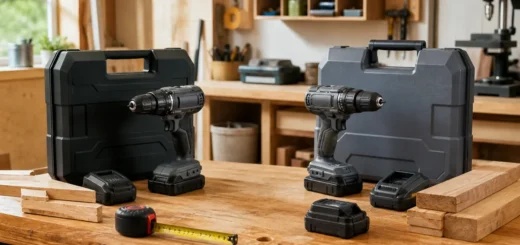
A drill is useful for pilot holes and driving screws, but there is no need to buy an impact driver just for one bench. A basic drill with a clutch is easier to control near the end of a screw. If you already own cordless tools, staying on that battery platform is usually better value than buying a second charger and battery system. If you are starting from zero, compare the kit price, battery capacity, and warranty—not just the bare-tool price. A cordless drill kit with two batteries costs more upfront than a corded drill, but it is more convenient for work away from an outlet.
Use screws long enough to pass through the rail and bite securely into the leg, but avoid driving them so close to an edge that the wood splits. Drill pilot holes near board ends, especially in dry or narrow stock. Construction screws are a reasonable value for a utility bench; drywall screws are brittle and are not a good substitute for structural fastening.
One or two pairs of budget bar clamps are enough for a small build, provided their bars do not visibly bow when tightened. Clamps help hold the frame square while fastening and keep a doubled top aligned during glue-up. Do not substitute clamps for a properly fastened frame: a bench that shifts under pressure needs better bracing, not simply tighter screws.
Where cheap tools fail—and where they do not
Low-cost tools are generally fine for a one-off bench, but inspect them before work. A saw with a loose base plate can make angled cuts; a drill with a badly wobbling chuck can enlarge holes; a tape measure with a bent hook can give inconsistent readings. Return a defective tool early rather than working around it.
Do not economize on eye protection, hearing protection, or dust control. Plywood cutting makes fine dust, and saw noise can be tiring even during a short job. Clamp the work securely, keep hands out of the blade path, and support the offcut so it does not pinch the blade. If your cuts are few and a neighbor or local makerspace can help, borrowing a saw may beat buying one that will sit unused.
When to buy and what to skip
Prices on tools and battery kits often dip around major holiday sales and seasonal promotions, but a discount is only worthwhile if the tool fits the job and the price is genuinely lower than its usual range. Check the total for the kit, charger, and batteries. A bare cordless tool advertised cheaply can be poor value if you need a battery platform from scratch.
Skip a table saw, router, and thickness planer for a simple workbench unless you already know you need them for later projects. They add cost, storage needs, and setup time. Spend instead on straight lumber, a flat top, a square, and a stable frame. That combination will build a serviceable bench without turning a modest project into a tool-buying exercise.