Best Budget Staple Gun for Upholstery and Home Repairs
What's inside
As an Amazon Associate I earn from qualifying purchases. This post may contain affiliate links at no extra cost to you.
A good upholstery staple gun does not need to be expensive, but the cheapest tool on the shelf can turn a simple repair into a hand and wrist workout. For most home projects, the best budget choice is a manual stapler with a comfortable handle, adjustable driving force, and support for common 1/4-inch to 9/16-inch staples. Electric models cost more, but they are easier to control when covering several chairs or attaching fabric to a large panel.
As an Amazon Associate we earn from qualifying purchases at no extra cost to you.

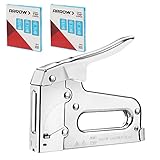

Best budget choice: a heavy-duty manual staple gun
A heavy-duty manual staple gun is the right starting point for occasional upholstery, repairing a dining chair, securing carpet edges, or attaching thin insulation and house wrap. Expect to spend roughly $15 to $30 for a usable tool. Models in this range generally accept T50-style staples or a similar common format, which keeps replacement staples inexpensive and easy to find.
Manual guns work well when the wood frame is soft pine, plywood, or fiberboard. They also give useful feedback: if a staple will not fully seat, you can feel the resistance before wasting a row of fasteners. The downside is fatigue. Driving 100 to 200 staples by hand can leave your palm sore, especially when the tool has a stiff trigger.
Look for a rubberized grip, a trigger that does not require excessive force, and a rear loading mechanism that is easy to open. A staple-depth adjustment is helpful but not essential for light upholstery. A staple remover, included with some kits, is worth having because misfired staples are common while learning.
Manual versus electric staple guns
| Type | Typical price | Best use | Main drawback |
|---|---|---|---|
| Light-duty manual | $10-$18 | Crafts, thin fabric, occasional repairs | Struggles with hardwood and thick material |
| Heavy-duty manual | $15-$30 | Chair seats, fabric panels, general home repairs | Hand fatigue on large jobs |
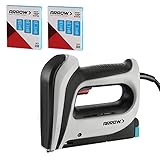
| Corded electric | $25-$50 | Several chairs or repeated stapling near an outlet | Cord limits movement and cheap models can misfire |
| Cordless electric | $50-$120 | Frequent work, large upholstery jobs, remote repairs | Higher cost and battery-platform commitment |
For one chair, a manual tool is usually the better value. A corded electric gun becomes attractive when you expect to drive several hundred staples in one session. It reduces hand strain and produces more consistent results, but it is not automatically more powerful. Inexpensive electric staplers can still leave staples proud of the surface if the frame is hard or the fabric stack is thick.
A cordless model makes sense mainly if you already own batteries from the same tool platform. Buying a battery and charger solely for a staple gun can double the real cost. If you do not need portability, a corded model often delivers more value.
Choose the right staple size
Staple length matters more than brand for upholstery results. For fabric over a wood seat frame, 1/4-inch staples are useful when the fabric is thin and the frame is shallow. 5/16-inch or 3/8-inch staples are common general-purpose choices. Use 1/2-inch staples only when there is enough wood thickness to hold them safely; a staple that is too long can break through the frame or hit a hard surface behind it.
As a starting rule, the staple should penetrate the wood by about 1/4 inch without exiting the other side. Count the fabric layers, batting, and dust cover before choosing. If the material stack is 1/8 inch thick, a 3/8-inch staple leaves roughly 1/4 inch for the wood. Test on scrap wood first.
Do not assume every “heavy-duty” gun takes the same staples. Check the tool’s listed staple range before buying. A gun designed for narrow-crown staples may not accept the wider staples used by another model. Assorted upholstery staples are convenient for testing, but buying one size in a larger pack is cheaper once you know what works.
Features worth paying for
Spend extra for a smooth trigger rather than decorative features. A force adjustment is useful when moving between soft pine and harder plywood. A jam-clearing system saves time, although it rarely eliminates jams entirely. The staple channel should open without tools, and the magazine should clearly show how many staples remain.
Weight is a trade-off. A very light plastic-bodied stapler may be comfortable for short craft jobs but can flex under pressure. A metal-bodied manual gun usually lasts longer and stays aligned, though it can weigh a pound or more. For upholstery, reliability and trigger comfort matter more than having the highest advertised driving force.
If you prefer powered operation, compare corded electric staple guns by staple range, not just motor wattage. A narrow range such as 1/4 to 3/8 inch may be adequate for fabric, while a wider range is more useful around the house.
How to avoid loose fabric and bent staples
Remove old staples completely and inspect the frame before covering it. Rotten wood, cracked plywood, and loose corner blocks cannot be fixed by using longer staples. Pull the fabric tight in the center of each side first, then work toward the corners. Place staples about 1 to 1 1/2 inches apart for normal upholstery, closer around curves if the fabric wants to lift.
Keep the gun square to the work surface and press down firmly before pulling the trigger or squeezing the handle. A tilted tool causes angled staples that can fold over or split the frame. If staples bend repeatedly, try a shorter staple, move slightly to fresh wood, or pre-compress thick batting. If they sit proud, increase driving force where adjustable or use a powered tool.
Best time to buy
Staple guns and upholstery supplies are commonly discounted during spring home-improvement promotions, late-summer back-to-school craft sales, and November holiday shopping events. Discounts of 15% to 30% are common on basic manual tools. Do not wait for a sale if the project is small: a $20 manual gun can be cheaper than a delayed repair or a second trip for the wrong staple size.
For most homeowners, buy a metal heavy-duty manual model and a box of 1/4-inch and 3/8-inch compatible staples. Upgrade to electric only when hand fatigue, volume, or mobility makes the manual tool inconvenient. The cheaper option is perfectly adequate when the job is one chair, a few loose fabric edges, or occasional household repairs.