Best Budget Combination Square for General Workshop Layout
What's inside
As an Amazon Associate I earn from qualifying purchases. This post may contain affiliate links at no extra cost to you.
A combination square is one of the cheapest ways to mark 90-degree cuts, check 45-degree miters, and set short distances from an edge. For general workshop layout, a budget model is often enough—but only if its head locks securely and its blade is straight. A low price is poor value if the rule slips halfway through a mark or the square reads noticeably out of true.
As an Amazon Associate we earn from qualifying purchases at no extra cost to you.


What to buy for general workshop layout
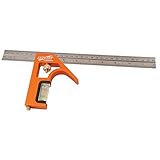
For a first square, look for a 12-inch combination square with a metal head, a graduated steel blade, a readable scale, and a replaceable locking screw or nut. A 12-inch blade reaches across common lumber and sheet-goods edges without being as awkward to store as a longer rule. A 6-inch square is handier for small parts, but it cannot span a full 2-by-4 face reliably.
At the budget end, choose a straightforward 12-inch combination square rather than paying extra for accessories you will not use. A center-finding head can be useful for round stock, and a protractor head can help with angle work, but neither improves the basic 90-degree check. If your work is mostly small hardware, a 6-inch combination square may be the more practical size.
Budget options compared
| Type | Typical use | Main trade-off |
|---|---|---|
| Basic 12-inch combination square | General layout, checking 90 and 45 degrees | Good reach for low cost; quality control can vary |
| Small 6-inch combination square | Small parts, hardware, compact storage | Easy to handle; too short for many boards |
| Cast-head budget square | Frequent workshop use and repeated adjustments | Can feel sturdier, but a rough or loose head still ruins accuracy |
| Machinist-style square | More demanding reference work | Often costs more; unnecessary for rough carpentry layout |
Prices and construction vary by seller, so judge the tool in hand when possible. A heavier head is not automatically more accurate. The blade should slide without binding, and the locking mechanism should hold it in place when you press the rule against a board. If you want to compare a step-up option, search for a 12-inch square with a steel head, but buy the better build only if the added durability matters in your shop.
Check it before trusting it
Do a quick accuracy check after purchase and after any hard drop. Put the blade against a straight, square-edged board and draw a line along the rule. Flip the square over, align the head to the same edge, and draw a second line beside the first. If the lines spread apart over 6 inches, the square is out of true enough to spoil close layout. A small difference may be acceptable for rough framing, but not for fitting a drawer or machine part.
Also check the blade against a known straightedge. Sight along both edges for a bow, and look for burrs near the graduations. A burr can keep the blade from seating flat against the work. Confirm that the head’s reference face is smooth and that tightening the lock does not rotate the blade. If it does, loosen it, reseat the rule, and test again; persistent movement is a reason to return the tool.
Use it without building in errors
Brush sawdust off the board edge and the square’s reference face before marking. Even a thin chip trapped under the head can tilt the rule. Hold the head snugly against the edge without forcing it, then mark with a sharp pencil or a knife. A wide carpenter’s pencil can make a line several millimeters thick; use a fine pencil for tighter fitting work.
For a 45-degree check, use the angled face of the head and confirm the blade is fully locked. Do not assume the printed angle is exact just because the scale is clear. Check a test mark against a known 45-degree cut or a reliable bevel gauge if the angle is important. For repeated cuts, use the square to set a saw or stop once, then verify the first cut before making a batch.
Combination squares can also transfer short measurements, but they are not substitutes for a long tape measure or a precision height gauge. The rule can shift if the lock is only finger-tight, and the graduations may be too coarse for fine metalwork. Treat it as a layout and checking tool, not a calibration instrument.
Where spending more pays off
Pay extra when you use the square daily, need repeatable measurements, or depend on it to set machinery. Better fit between blade and head, sharper graduations, and a lock that stays put can save time and reduce rework. For occasional shelf brackets, garden projects, or rough lumber layout, a basic square that passes the flip test is usually sufficient.
Seasonal sales can make branded tools more attractive, but compare the final price with a plain budget square and inspect the actual features. A bundle with extra heads is worthwhile only if you will use them. Avoid choosing on brand name alone: a premium label cannot compensate for a blade that is bent or a head that rocks on the board.
Keep a budget square useful
Store the square where its blade cannot be bent, and wipe it dry after use in a damp shop. Rust spots near the scale make readings harder; a light coat of machine oil helps prevent corrosion, but wipe off excess before marking wood. Do not use the blade as a pry bar or hammer guide. If the locking screw loosens repeatedly, check for damaged threads rather than over-tightening it, which can strip the head.
For most home workshops, the best value is a simple 12-inch combination square that passes a basic accuracy check and locks firmly. Spend more for sturdier construction or tighter work, not for a longer feature list. When the tool fails the flip test, slips under hand pressure, or arrives with a bent blade, return it rather than trying to compensate in every layout mark.