Best Budget Benchtop Sander for Small Woodworking Projects
What's inside
As an Amazon Associate I earn from qualifying purchases. This post may contain affiliate links at no extra cost to you.
A benchtop sander earns its space when you make small parts regularly: cabinet doors, boxes, toys, trim, or furniture components. For occasional touch-ups, a sanding block or drill-mounted drum may cost less and take up less room. For repeat work, a compact belt-and-disc machine is usually the best budget starting point because it handles straight edges and curves without requiring two separate tools.
As an Amazon Associate we earn from qualifying purchases at no extra cost to you.
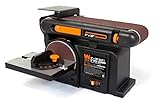


Best budget pick: a belt-and-disc sander
Look for a benchtop combination sander with a belt around 4 by 36 inches and a disc around 6 inches. That format offers a useful balance of capacity, replacement-abrasive availability, and price. A 4-by-36-inch belt is long enough to sand an edge or small board, while the disc is handy for squaring short ends against a table and miter gauge.
Compare benchtop belt-and-disc sanders by table size, belt-tilt range, dust-port location, and the cost of compatible abrasives—not just motor power. Many entry-level units fall in the roughly 3-to-5-amp range, but amperage alone does not tell you how well a machine stays aligned or resists vibration.
Which sander suits the job?
| Type | Best use | Typical trade-off | Budget verdict |
|---|---|---|---|
| Belt-and-disc | Edges, small end-grain faces, mixed projects | More footprint and setup than a single-purpose tool | Best all-round value for regular small-shop use |
| Oscillating spindle | Inside curves and shaped cutouts | Cannot efficiently flatten straight edges | Buy when curved interiors are a recurring task |
| Small belt sander | Long edges and broad faces on small parts | Less useful for end-grain squaring or tight curves | Fine if you rarely need a disc |
| Hand sanding block | Occasional cleanup and delicate parts | Slower and less consistent across many pieces | Cheapest choice for infrequent work |
What to check before buying
Table and fence: A small, flat table matters more than a large advertised motor. Check whether it locks securely at 90 degrees and whether the miter gauge has little side play. A loose gauge can turn a supposedly square end into a slightly skewed one. If possible, inspect the table with a reliable square; inexpensive castings can have rough edges or need adjustment.
Belt tracking and changes: The belt should run centered without constant correction. A basic tracking knob is normal, but a belt that walks off during light use is a return-worthy problem. Tool-free belt changes save time, though they are not essential if you rarely switch grits.
Dust collection: A dust port is not the same as effective dust control. Ports on budget machines may be small or poorly placed, and fine dust can still escape. Check the port diameter before purchase and expect to use a shop vacuum or dust collector. Wear a suitable respirator when sanding, especially hardwoods and sheet goods.
Abrasive availability: Replacement belts and discs are a recurring cost. Search for the machine’s exact abrasive dimensions and confirm that common grits are sold individually or in affordable packs. Starting with 80 or 100 grit and finishing around 150 or 180 is practical for many shaping jobs; finer grits are usually better handled by hand or a random-orbit sander.
When the cheaper option is enough
If you sand a few small parts a month, skip the machine. A sanding block with 80-, 120-, and 180-grit paper is inexpensive, quiet, and less likely to round over a precise edge. A handheld belt sander can also be cheaper if you already own one, but holding it steady against a tiny workpiece is awkward and can be unsafe.
Choose a single-purpose spindle sander instead of a combination unit if most of your work involves inside curves from a scroll saw or jigsaw. Spindle sanders use sleeves in several diameters, commonly from about 1/2 inch upward. They are much better at smoothing concave shapes, but they are the wrong purchase if your main task is squaring straight edges.
Getting accurate results without burning parts
Sand with the work supported flat on the table, and keep fingers clear of the abrasive’s pinch points. On the disc, work on the side that moves down toward the table; using the opposite side can lift the workpiece. Feed slowly and let the abrasive cut. Pressing hard overheats small parts, clogs the paper, and can pull a piece from your hands. Very small or narrow parts should be held in a jig or against a suitable push block, not pinched close to the belt.
Check the table angle with a square before precision work, then test on scrap from the same material. A 1/16-inch error across a short edge can be obvious in a small box joint or frame. Keep the abrasive clean, and replace it when it stops cutting rather than compensating with pressure. Dull paper is a common cause of burn marks and rounded corners.
When to buy and what to pay for
Benchtop sanders often see discounts during major holiday sales and around Black Friday, but a lower sticker price is not a bargain if replacement belts are hard to find or the machine arrives with poor alignment. Compare the delivered price, return policy, abrasive costs, and warranty. A modestly better-made unit can be better value if you use it every week; for occasional hobby work, the least expensive model with stable tables and readily available abrasives may be entirely adequate.
For small woodworking projects, start with a 4-by-36-inch belt and 6-inch disc combination sander if you need one machine for several tasks. If curved cutouts dominate, look instead at benchtop oscillating spindle sanders. Buy for the shapes you actually sand, not the number of features on the box.