How to Budget for Tools Needed During a Bathroom Renovation
What's inside
As an Amazon Associate I earn from qualifying purchases. This post may contain affiliate links at no extra cost to you.
A bathroom renovation rarely requires a full contractor’s tool collection, but it does demand a few tools that can prevent expensive mistakes. A realistic DIY tool budget is about $150 to $300 for a basic cosmetic update, $350 to $700 for flooring, tile, or plumbing work, and $700 or more if you need cordless tools, specialty cutters, or demolition equipment.
Budget for tools separately from materials. A $40 mistake caused by a poor hole saw or inaccurate level can quickly damage a $300 vanity, a shower valve, or a box of tile. The goal is not to buy the cheapest tool in every category. It is to spend on accuracy, dust control, and tools that will survive the work.
As an Amazon Associate we earn from qualifying purchases at no extra cost to you.


Start With the Scope of the Renovation
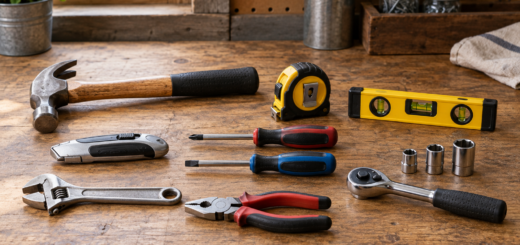
List the tasks before shopping. Painting walls and replacing hardware may require little beyond a drill, caulk tools, a scraper, and measuring equipment. Installing tile adds a wet saw or tile cutter, notched trowels, spacers, grout tools, and knee protection. Replacing a toilet or faucet requires basin wrenches, adjustable wrenches, pliers, and possibly a tubing cutter. Moving supply lines or drains raises the need for specialized plumbing tools and increases the cost of failure.
For a simple bathroom refresh, set aside roughly $50 for measuring and hand tools, $60 to $120 for a drill and accessories, and $30 to $70 for caulking, surface preparation, and cleanup. For a tile project, add $100 to $250 for cutting equipment. Renting a wet saw can be cheaper than buying one if you have only one bathroom and expect less than a week of cutting.
Where to Spend and Where to Save
Spend more on tools that control straightness, hole size, or water connections. A reliable 24-inch level, sharp drill bits, a quality diamond hole saw, and a solid adjustable wrench are worth paying for. Cheap versions often flex, wander, or damage fasteners. Spend less on disposable mixing buckets, tile spacers, sanding blocks, and basic scrapers. These items wear out or become contaminated with adhesive and grout anyway.
| Tool category | Budget range | What a budget tool is good for | When to upgrade |
|---|---|---|---|
| 25-foot tape measure | $10–$20 | Most bathroom measurements | If the hook is loose or the blade kinks |
| 24-inch level | $15–$45 | Vanities, shelves, trim, and cabinets | When accuracy matters over long runs |
| Cordless drill and bit set | $60–$180 | Fastening hardware and drilling anchors | For frequent use, masonry drilling, or better clutch control |
| Tile cutter or wet saw | $50–$300 | Straight cuts in ceramic and some porcelain | For thick porcelain, many cuts, or plumbing openings |
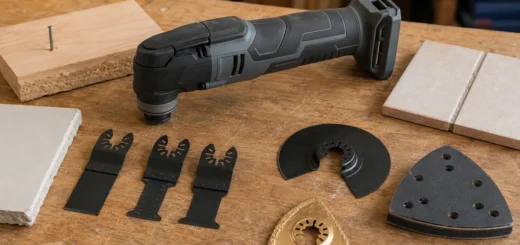
| Oscillating multitool | $70–$180 | Cutting trim, grout, and small openings | For heavy demolition or extended cutting |
| Plumbing hand tools | $35–$100 | Faucets, toilets, shutoff valves, and traps | When access is tight or fittings are corroded |
Compare Cordless Tool Brands Carefully
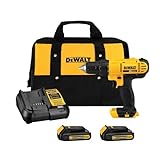
If you already own batteries, staying with that brand is usually the best value. A bare tool may cost $40 to $100 less than a kit, and shared batteries eliminate duplicate chargers. If you are starting from nothing, compare the complete system price rather than the drill alone. A $99 kit with two small batteries can be more useful than a $79 tool sold without a battery.
For one bathroom, an entry-level 12-volt drill is often enough for cabinet hardware, anchors, and pilot holes. Choose an 18- or 20-volt system if you will drill through studs, mix small batches of thinset, or reuse the tools for deck, garage, or exterior work. Premium brands generally offer better ergonomics, brushless motors, and larger battery choices, but those advantages are difficult to justify for a single light renovation.
A good cordless drill driver kit should have a clutch with several settings, a two-speed gearbox, and at least one battery of 2.0 amp-hours or more. Avoid bargain kits with vague battery ratings, excessive wobble in the chuck, or no replacement batteries available.
Budget for Tile Cutting and Demolition
A manual tile cutter is economical for straight cuts in standard ceramic tile. Expect to pay $50 to $120 for a usable homeowner model. The failure mode is chipped glaze or a score line that does not break cleanly, especially on hard porcelain. A wet saw costs more and takes longer to set up, but it handles porcelain better and produces cleaner repeated cuts. Check rental prices before buying; a two-day rental of $60 to $100 can beat storing a $200 saw.
Do not assume a drill bit made for wood will handle tile. Use carbide bits for ceramic and diamond-grit bits for porcelain or glass. Keep the bit cool with water when the instructions call for it. Forcing a dry diamond hole saw overheats the rim and can crack the tile around the hole.
Demolition tools are another place where renting makes sense. A pry bar, hammer, scraper, and oscillating multitool kit cover careful removal of trim, caulk, grout, and small sections of drywall. A reciprocating saw is useful for larger tear-outs but can cut hidden plumbing or electrical wiring in seconds. Buy it only if the demolition justifies the risk and you can inspect the wall first.
Do Not Underbudget Plumbing and Finishing Tools
A basin wrench, tongue-and-groove pliers, adjustable wrench, utility knife, and tubing cutter can cost $40 to $90 together. These are cheaper than calling a plumber to repair a rounded nut or kinked supply line. Replace old shutoff valves rather than forcing them if they do not close fully. A seized valve can break inside the wall when you apply more leverage.
For caulk, budget $10 to $25 for a smooth-running gun and quality bathroom sealant. Cheap caulk guns leave gaps because the plunger slips or the trigger requires excessive force. Keep a dedicated caulk removal tool and denatured-alcohol-compatible cleaning supplies, following the sealant label. A poor joint often fails because the surface was damp, dusty, or still coated with soap—not because the tube was inexpensive.
Also allow $25 to $60 for safety and cleanup: eye protection, gloves, a respirator rated for the dust involved, drop cloths, plastic sheeting, and heavy trash bags. Wet tile cutting and drywall sanding create fine dust and slurry that can ruin a shop vacuum or clog household drains.
Time Purchases Around Sales and Rentals
Tool sales commonly improve around Memorial Day, July 4th, Labor Day, Black Friday, and major holiday weekends. Battery kits and starter bundles are often discounted more deeply than individual tools. Buy based on the normal price, not the claimed percentage off, and check whether the kit includes a charger and usable battery.
Buy consumables immediately before the task so they are fresh and matched to the material. Rent wet saws, demolition hammers, and specialty drain tools when their ownership cost exceeds likely future use. For a one-time bathroom renovation, a carefully chosen drill, accurate level, plumbing hand-tool set, and quality tile accessories usually deliver better value than a garage full of inexpensive power tools.